Agile vs. Waterfall vs. Hybrid: Which Works for Software Projects?
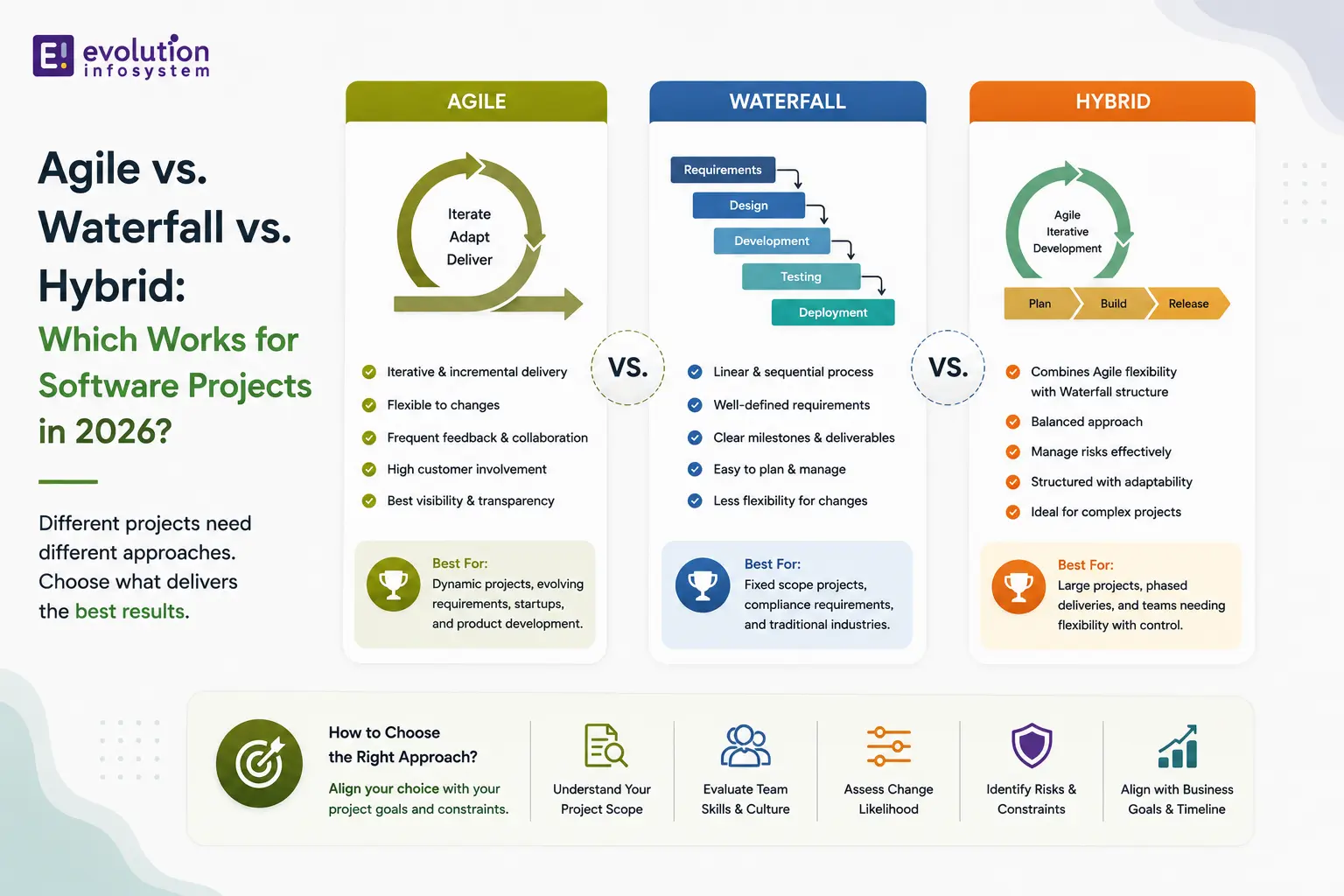
The Agile vs. Waterfall debate has been running for over two decades. Today, it’s more settled than the ongoing discussion suggests – but the answer isn’t “Agile always wins.” The right methodology depends on what you’re building, who you’re building it for, and how stable your requirements are.
What has changed is the emergence of Hybrid as a legitimate, structured approach rather than an improvised compromise. For many software projects – particularly those with a mix of fixed regulatory requirements and evolving product features – Hybrid is the right answer, not a fallback.
Here’s the breakdown.
Waterfall: What It Is and When It Still Makes Sense
Waterfall is a sequential development methodology. Requirements are defined in full before design begins. Design is completed before development begins. Development is completed before testing begins. Testing is completed before deployment. Each phase has defined deliverables that must be approved before the next phase starts.
This approach is rigid by design. Once requirements are signed off, changes are formally controlled – assessed for impact, priced, approved, and scheduled. The assumption is that the right thing to build can be defined completely upfront.
Waterfall has an earned bad reputation in product development contexts where requirements genuinely evolve. But it has an equally earned good reputation in contexts where requirements are stable, fully definable, and change is genuinely expensive.
Where Waterfall is the correct choice:
Regulated industries with fixed compliance requirements – medical devices, financial systems, aerospace software – where every requirement must be traceable, documented, and validated before the system ships. Regulatory bodies don’t accept “we iterated to this” as a compliance narrative.
Fixed-scope, fixed-timeline government and enterprise contracts where the deliverable is legally specified and deviation from the specification has contractual consequences. In these contexts, Waterfall’s formal change control is a feature, not a limitation.
Infrastructure and migration projects with clear technical scope – database migrations, system integrations, hardware-coupled software – where the requirements are determined by the existing systems rather than by evolving user needs.
Agile: What It Actually Means in Practice
Agile is not a single methodology – it’s a set of values, expressed through frameworks like Scrum, Kanban, and SAFe. The core premise is that software requirements evolve, and a development process should accommodate that evolution rather than resist it.
In practice, Agile development works in short iterations (sprints of 1–4 weeks), with each sprint producing working, testable software. Priorities are reviewed at the start of each sprint. Requirements evolve based on what the previous sprint revealed. Feedback loops between developers and stakeholders are short and frequent.
The advantage of this approach is responsiveness. When users interact with working software and provide feedback, requirements clarify in ways they couldn’t from a written specification alone. Agile accommodates this – it expects it.
Where Agile is the correct choice:
Product development where user needs and market requirements are genuinely uncertain and will evolve through discovery. Startups building consumer or B2B products, companies developing new digital products in established businesses, and any situation where “we’ll know more once we see it working” is an accurate description of the product development process.
Applications where the competitive landscape requires continuous iteration. In markets where competitors are shipping features monthly, a development process that produces testable software in 2-week cycles is structurally advantaged over one that produces a comprehensive release every 6 months.
Cross-functional teams with strong collaboration between product, design, and engineering. Agile requires sustained communication and shared ownership of outcomes. Teams structured for this collaboration get its full benefit.
Where Agile struggles:
Agile is frequently misapplied to projects with fixed external requirements – regulatory, contractual, or technically constrained – where the flexibility it provides isn’t useful and the absence of comprehensive upfront documentation creates compliance or delivery risk.
Agile also degrades quickly when adopted superficially – sprint ceremonies without genuine iterative delivery, velocity metrics without outcome focus, “agile” framing applied to what is functionally a Waterfall project without the documentation. This is common enough to have a name: “Wagile.” It produces neither Agile’s responsiveness nor Waterfall’s predictability.
Hybrid: The Structured Middle Ground
Hybrid methodologies combine Waterfall’s upfront planning and documentation with Agile’s iterative delivery. Today, Hybrid has become the dominant approach for enterprise software projects precisely because most enterprise software exists in the space between the two pure models.
A typical Hybrid structure: Waterfall-style requirements definition and architecture planning for the foundation of the system, followed by Agile sprints for feature development, with Waterfall-style validation and documentation for compliance-critical components.
This isn’t compromise – it’s appropriate methodology selection at the component level. Different parts of a software project genuinely have different characteristics. The database schema and security architecture of an enterprise system benefit from the thoroughness of Waterfall planning. The user-facing features of the same system benefit from the iterative feedback loops of Agile delivery.
Where Hybrid is the correct choice:
Enterprise systems with both regulatory requirements and evolving product features. A healthcare platform, for example, may have HIPAA-compliant infrastructure requirements that need Waterfall rigor alongside a patient-facing interface that benefits from Agile iteration.
Large-scale projects with multiple teams working on components of different types. Waterfall for infrastructure and integration layers, Agile for product and feature layers, with defined integration points between them.
Organizations transitioning from Waterfall to Agile. Hybrid provides a structured path that accommodates existing governance and documentation requirements while building Agile capability incrementally.
Side-by-Side Comparison
| Factor | Waterfall | Agile | Hybrid |
|---|---|---|---|
| Requirements | Fully defined upfront | Evolve iteratively | Fixed for core, flexible for features |
| Delivery | Single release at end | Working software each sprint | Phased, with iterative feature delivery |
| Change handling | Formal change control | Built-in, expected | Structured for core, flexible for features |
| Documentation | Comprehensive | Lightweight | Comprehensive for regulated components |
| Client involvement | Front and back | Continuous | Varies by phase |
| Best for | Regulated, fixed-scope | Product development | Enterprise, mixed requirements |
| Risk profile | Late discovery of issues | Early discovery, continuous | Managed by component type |
How to Choose
Three questions determine the right methodology:
1. How stable are your requirements?
If requirements can be fully defined upfront and are unlikely to change materially, Waterfall is manageable. If requirements will evolve through discovery and user feedback, Agile or Hybrid.
2. What are your compliance and documentation obligations?
Regulated industries and government contracts have documentation requirements that Agile alone doesn’t satisfy. Waterfall or Hybrid.
3. How frequently do you need to see working software?
If stakeholders need to see and test working software regularly to validate direction, Agile’s sprint cadence provides this. If the project is well-defined enough that a phased delivery works, Waterfall or Hybrid.
For most commercial software products – SaaS, mobile applications, e-commerce platforms, internal tools – Agile (specifically Scrum with 2-week sprints) is the right choice. For regulated systems and large enterprise projects, Hybrid is increasingly the appropriate answer. Pure Waterfall is the right choice less often than it was – but in its appropriate context, it remains the right choice.
Frequently Asked Questions (FAQs)
Is Agile better than Waterfall for software development in 2026?
For most commercial software product development, yes. Agile’s iterative delivery and built-in feedback loops produce better outcomes when requirements evolve through discovery. Waterfall remains the better choice for regulated, fixed-scope, and compliance-heavy projects where comprehensive upfront documentation is required.
What is a Hybrid methodology in software development?
A Hybrid methodology combines Waterfall’s upfront planning and documentation with Agile’s iterative development. It’s typically applied by using Waterfall rigor for stable, well-defined components (architecture, infrastructure, compliance requirements) and Agile sprints for evolving product features.
What is “Wagile” and why should you avoid it?
Wagile is the informal term for Agile ceremonies applied to what is functionally a Waterfall process – sprint planning and stand-ups without genuine iterative delivery, or “agile” framing used to avoid the documentation that the project actually requires. It produces neither Agile’s responsiveness nor Waterfall’s predictability. If you’re going to use a methodology, use it properly.
How do I know which software development methodology is right for my project?
Evaluate three factors: how stable your requirements are, what your compliance and documentation obligations are, and how frequently stakeholders need to validate direction with working software. Stable requirements and compliance obligations point to Waterfall or Hybrid. Evolving requirements and continuous feedback needs point to Agile.
At Evolution Infosystem, we use the methodology that fits the project – not the one that’s easiest to sell. For most product builds, that’s Agile. For enterprise and regulated systems, it’s Hybrid. We’ll tell you which one fits your situation and why. Let’s talk.