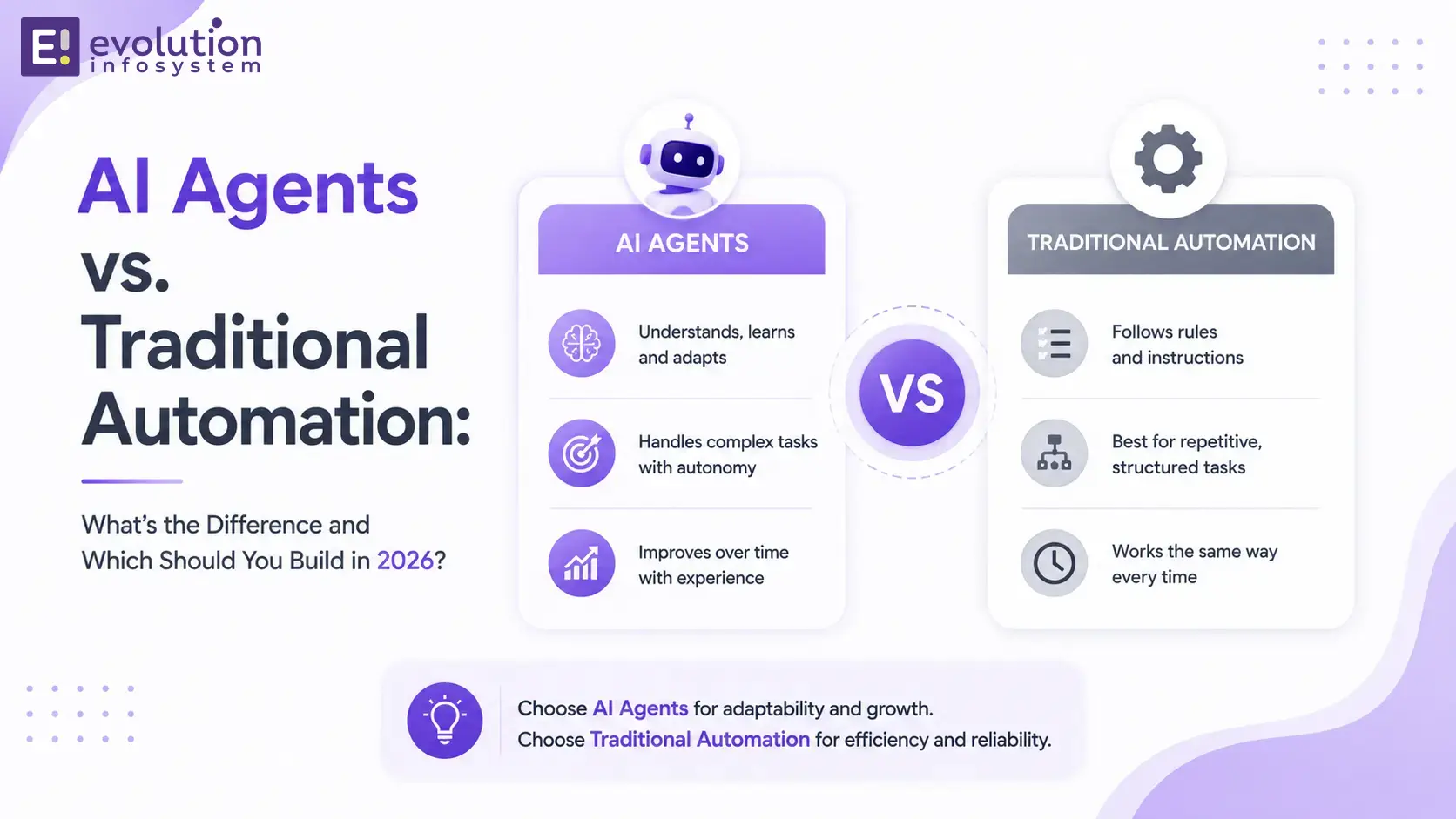
AI Agents vs. Traditional Automation: What's the Difference and Which Should You Build in 2026?
“We want to automate this” is a sentence that used to have one answer. In 2026, it has at least two – and picking the wrong one will cost you either speed (if you over-engineer) or capability (if you under-build).
Traditional automation has existed in enterprise software for decades. AI agents are the new force reshaping how businesses think about automation entirely. The two are often conflated. They shouldn’t be. They solve different problems, operate on different principles, and require different infrastructure to build and maintain.
Here’s the no-nonsense breakdown.
What Is Traditional Automation?
Traditional automation – covering rule-based scripts, workflow automation tools, and Robotic Process Automation (RPA) – operates on explicit, pre-defined logic. A human defines every decision point. If X happens, do Y. If Y fails, do Z. The system does exactly what it’s told, in the order it’s told, every time.
Common forms of traditional automation in 2026:
- RPA: Software bots that mimic human actions in UIs – clicking, copying, form-filling – without requiring API access. Tools like UiPath, Automation Anywhere, and Blue Prism dominate this space.
- Workflow automation: Trigger-action logic connecting applications. Zapier, Make (formerly Integromat), and n8n sit here. If a form is submitted, create a CRM record and send an email.
- Business process automation (BPA): More sophisticated workflow orchestration managing multi-step, multi-system processes with branching logic, approvals, and escalations.
The core characteristic: Every decision path is explicitly coded by a human. The system has zero capacity to handle a situation its rules don’t cover.
What Is an AI Agent?
An AI agent is an autonomous system that uses a large language model (LLM) as its reasoning engine. Rather than following explicit rules, it interprets a goal, plans a sequence of steps to achieve it, selects and uses available tools (APIs, databases, search, code execution), evaluates its own outputs, and adapts based on results – all with minimal human instruction.
The technical loop looks like this:
- Receive a goal (not a set of instructions – a goal)
- Reason about how to achieve it
- Select a tool to take action (web search, API call, file write, database query)
- Execute the action
- Evaluate the result
- Iterate – adjust if the result is insufficient, or proceed to the next step
This loop runs autonomously until the goal is achieved or a human checkpoint is triggered.
Examples of AI agents in production in 2026:
- A sales agent that researches a prospect, drafts an outreach email, and queues it for human review – triggered by a new CRM entry
- A support agent that retrieves relevant documentation, drafts a resolution, checks company policy, and escalates only when it lacks confidence
- A data pipeline agent that monitors anomalies, investigates root causes across connected systems, and files a report without manual intervention
- A software development agent that takes a bug ticket, reproduces the issue, writes a fix, and opens a pull request
The Core Differences: Side by Side
| Factor | Traditional Automation | AI Agents |
|---|---|---|
| Decision making | Rule-based, explicit | Reasoning-based, contextual |
| Handles exceptions | No – breaks or fails | Yes – adapts to novel situations |
| Setup | Define every rule upfront | Define a goal and tools |
| Maintenance | Updates required for every process change | More resilient to workflow variation |
| Unstructured data | Poor – needs structured inputs | Strong – handles text, documents, natural language |
| Explainability | High – every step is auditable | Lower – reasoning is probabilistic |
| Cost to build | Lower initially | Higher initially |
| Cost at scale | Predictable | Variable (LLM API costs per call) |
| Best for | High-volume, stable, structured processes | Complex, variable, judgment-required tasks |
| Failure mode | Rigid – breaks at edge cases | Hallucination – confident but wrong |
Where Traditional Automation Still Wins
Do not abandon traditional automation for AI agents because agentic AI is the current trend. That is a mistake. Traditional automation dominates where:
✓ Volume is high and the process is stable. Processing 10,000 invoices overnight? Syncing data between two systems every hour? Sending confirmation emails after purchases? Rule-based automation is faster, cheaper, and more reliable for these tasks than any agentic solution.
✓ Auditability is non-negotiable. Finance, compliance, and regulated industries need a complete, deterministic audit trail. Every decision must be attributable to an explicit rule. An AI agent’s probabilistic reasoning doesn’t meet this bar.
✓ The data is structured. Traditional automation excels when inputs are consistent and well-formed – database records, form submissions, API payloads. It breaks when inputs are variable or unstructured.
✓ Cost predictability matters. Traditional automation has a fixed-cost profile once built. AI agents incur LLM API costs per invocation. At high volume, this is a real operational cost to model carefully.
According to research from 2025, traditional automation provides exceptional value for high-volume, repetitive tasks. In 2026, RPA is not dying – it is becoming the execution layer that AI agents orchestrate.
Where AI Agents Win
The process involves judgment, not just rules. Triaging a support ticket, deciding whether a contract clause needs legal review, determining why a campaign underperformed – these require contextual reasoning that rule-based systems can’t provide.
✓ Inputs are unstructured or variable. Emails, documents, transcripts, support tickets, user messages – AI agents handle these naturally. Traditional automation breaks on anything that doesn’t conform to expected formats.
✓ Exceptions are the norm. If your “automated” process currently requires a human to handle 30% of cases manually, you don’t have a traditional automation problem. You have an AI agent use case.
✓ The workflow changes frequently. Rule-based systems require manual updates every time a process changes. AI agents, given a goal and tools, adapt to workflow variation more gracefully.
By 2026, 80% of enterprise applications are expected to embed agentic capabilities. The question is no longer whether AI agents belong in enterprise automation stacks – it’s which tasks to build them for first.
The Hybrid Reality: RPA + AI Agents
The most effective enterprise automation stacks in 2026 don’t choose between traditional automation and AI agents – they use both, deliberately.
The architecture: RPA and workflow automation handle high-volume, structured, predictable tasks. AI agents handle the exceptions, the unstructured inputs, and the judgment calls. The two systems hand off to each other.
Example: An accounts payable automation.
- RPA extracts invoice data from emails and uploads to the ERP (structured, high-volume, deterministic)
- An AI agent handles invoices that don’t match expected formats, researches discrepancies against purchase orders, and flags outliers with a recommendation
- Humans review only the flagged cases
The result: 90% of invoices processed without human touch. The remaining 10% handled with AI-assisted context instead of a human searching through records manually.
This hybrid model – where traditional automation is the execution backbone, and AI agents are the exception-handling intelligence layer – is the dominant pattern in enterprise automation in 2026.
How to Decide What to Build
Run your use case through these four questions:
1. Is the process stable and the data structured?
Yes → Traditional automation. No → Evaluate AI agents.
2. Does the task require judgment, interpretation, or handling of natural language?
Yes → AI agent. No → Traditional automation.
3. How often does the process change?
Rarely → Traditional automation is maintainable. Frequently → AI agents handle variation better.
4. What is your tolerance for probabilistic outputs?
Zero (regulated, compliance-critical) → Traditional automation or AI agent with strict output validation and human-in-the-loop. Moderate → AI agent with guardrails.
Building AI Agents in 2026: The Technical Reality
If you’ve decided your use case warrants an AI agent, here’s what building one actually involves:
- LLM backbone: GPT-4o, Claude Opus/Sonnet, or Gemini 2.0 are the most widely deployed in production agentic systems.
- Orchestration framework: LangChain, LlamaIndex, and CrewAI are the most widely adopted in 2026 for multi-step and multi-agent orchestration.
- Tool definitions: Every capability the agent can use must be defined as a tool with a clear description. The LLM reads these descriptions to decide what to call. Clear, precise tool descriptions are as important as prompt quality.
- Memory: Agents need context across steps. Short-term memory lives in the context window. Long-term memory requires external storage – typically a vector database or a structured key-value store.
- Human-in-the-loop checkpoints: For any consequential action (sending an email, modifying a database, initiating a payment), build a checkpoint that requires human approval before execution. Autonomous doesn’t mean unaccountable.
- Observability: Log every reasoning step, every tool call, every output. You cannot debug a production agent without full trace visibility. LangSmith and Langfuse are the primary observability tools for agentic systems in 2026.
The Risks to Take Seriously
- Hallucination at action points. An AI agent that hallucinates in a generation task produces bad text. An AI agent that hallucinates in an action task – writing to a database, sending a communication – produces real-world consequences. Guardrails on all action steps are non-negotiable.
- Runaway cost. A poorly designed agent loop can make dozens of LLM calls per task. At production volume, uncapped agentic loops become expensive fast. Always set maximum iteration limits and token budgets per agent run.
- Agent washing. In 2026, industry analysts estimate only a small fraction of products marketed as “AI agents” are genuinely agentic. Most are enhanced chatbots or API wrappers. If you’re evaluating vendors, ask specifically: does the system plan multi-step tasks autonomously, and can it choose between tools at runtime?
How Evolution Infosystem Builds Automation
We assess the full automation landscape before recommending a build approach – whether that’s traditional RPA, workflow automation, an AI agent, or a hybrid system.
We’ve built agentic workflows for sales, support, operations, and data pipelines. We’ve also built traditional automation for high-volume, compliance-critical processes where reliability and auditability matter more than intelligence.
The goal is always the same: reduce manual overhead, eliminate bottlenecks, and build systems that scale without scaling headcount at the same rate.
If you have a process that feels too complex for traditional automation but you’re not sure whether AI agents are the right answer, talk to us. We’ll give you a straight answer.
Frequently Asked Questions (FAQs)
What is the difference between RPA and AI agents?
RPA follows fixed, rule-based scripts to automate structured tasks – clicking, copying, form-filling. AI agents use LLMs to reason, plan, and execute multi-step tasks autonomously, including handling unstructured data and exceptions. RPA is deterministic. AI agents are adaptive.
Are AI agents replacing traditional automation?
No. They’re complementary. Traditional automation handles high-volume, structured, stable processes better and more cheaply than AI agents. AI agents handle exceptions, judgment calls, and unstructured inputs that traditional automation can’t. The strongest enterprise automation stacks in 2026 use both.
How long does it take to build an AI agent?
A simple, single-tool AI agent can be built in 2–4 weeks. A production-grade multi-agent system with full observability, human-in-the-loop checkpoints, and comprehensive eval infrastructure typically takes 8–16 weeks, depending on the complexity of tools and workflows involved.
What industries are using AI agents in 2026?
Financial services (compliance monitoring, document review), e-commerce (customer support, personalisation), software development (code review, bug triage), healthcare (clinical documentation, prior authorisation), and professional services (research, report generation) are the most active sectors deploying agentic AI in production.
Let’s Build: Evolution Infosystem is an AI-driven software development company offering AI agent development, cognitive process automation, LLM integration, and custom software services globally. Contact us to scope your automation project.