Blockchain in Supply Chain: Real Use Cases That Actually Work
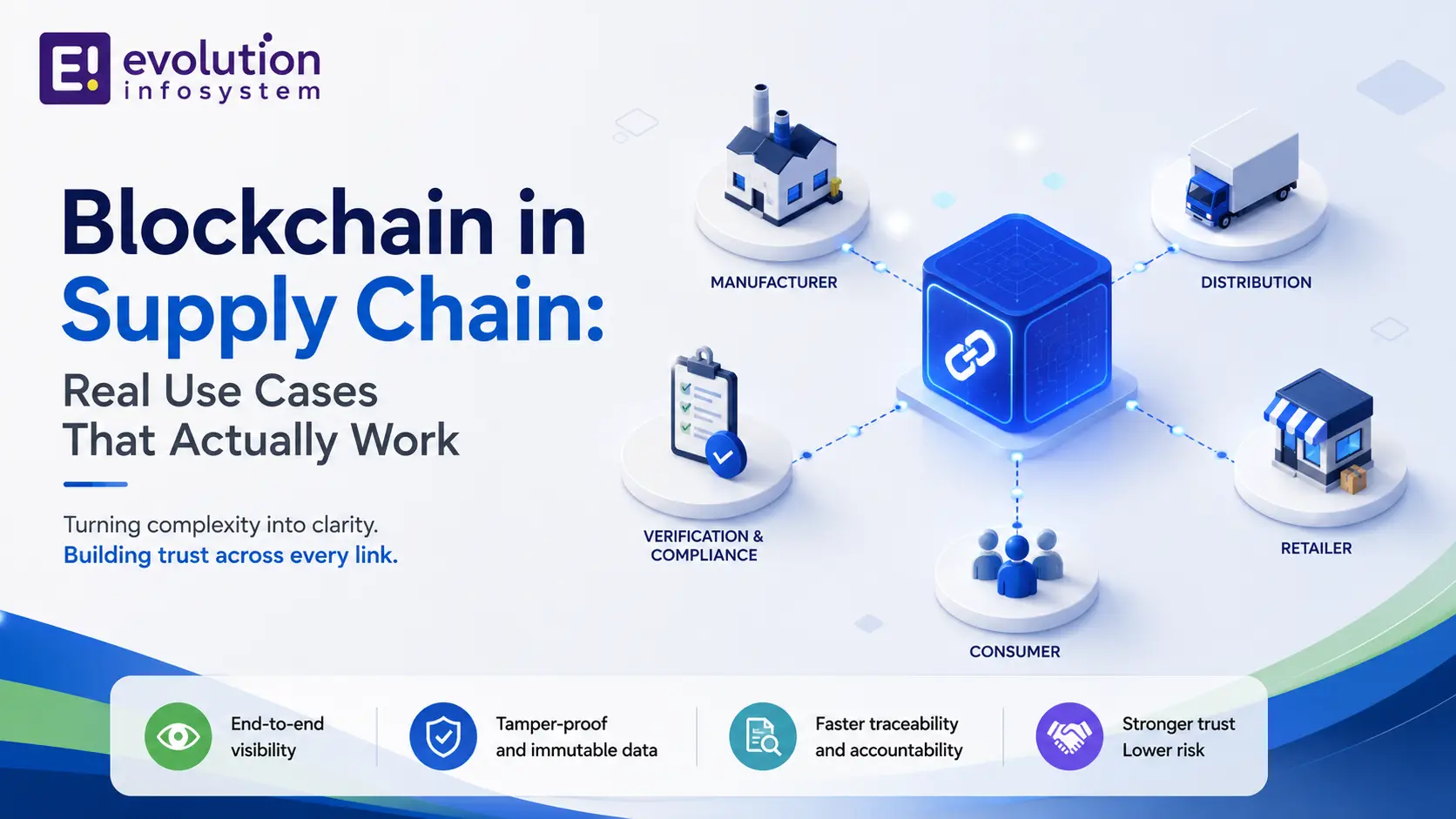
Between 2016 and 2021, hundreds of companies launched blockchain supply chain pilots. Most of them quietly died. The technology was real, the intentions were genuine, and the failure rate was high enough that “blockchain supply chain” became associated with enterprise hype rather than practical value.
But underneath the hype cycle, a smaller number of blockchain in supply chain implementations have been running in production for years, delivering measurable value in specific, well-defined supply chain problems. The pattern that separates working blockchain supply chain implementations from failed pilots is consistent, and it’s worth understanding before deciding whether blockchain solves your specific problem.
What Blockchain Actually Does in a Supply Chain Context
Before getting into use cases, it’s worth being precise about what blockchain contributes to a supply chain system – because imprecision here is what drove most of the failed pilots.
Blockchain provides an immutable, shared record of events across multiple parties who don’t fully trust each other. That’s it. That’s the core contribution.
This means blockchain is valuable in supply chain scenarios where:
- Multiple independent parties need to record and verify the same events
- No single party should have unilateral control over the record
- The authenticity and immutability of the record has real business or legal value
- The parties involved cannot, or do not want to, share a centralised database
If your supply chain problem doesn’t have all four of these characteristics, blockchain is probably not the right tool. A centralised database is simpler, faster, cheaper to operate, and easier to maintain for problems that involve a single organisation or where one party’s record is the authoritative source.
The Use Cases That Actually Work
1. Food Safety and Traceability
This is the most mature blockchain supply chain use case, and it has the clearest value proposition. When food contamination occurs, identifying the source quickly is both a public health imperative and an operational necessity. The 2018 E. coli outbreak linked to romaine lettuce required weeks to trace manually through paper records across multiple farms, distributors, and retailers.
Walmart, in collaboration with IBM Food Trust (built on Hyperledger Fabric), implemented blockchain-based food traceability for mangoes in the US and pork in China. The result: tracing a food item’s origin dropped from 7 days to 2.2 seconds.
The blockchain enables this because the record of each supply chain event – harvest, packing, shipping, storage temperature, retail receipt – is recorded by each party in the chain as it happens. No single party controls the data. The record is auditable by any authorised party. In a contamination event, the full chain of custody is immediately visible.
Why it works here: multiple independent parties (farms, logistics companies, distributors, retailers), high-stakes authenticity requirement, shared interest in the record’s accuracy, and a clear regulatory and brand protection business case.
2. Pharmaceutical Supply Chain and Anti-Counterfeiting
The pharmaceutical supply chain has a counterfeiting problem. The World Health Organisation estimates that 10% of medicines in low and middle income countries are falsified or substandard. In some regions, the figure is higher. Counterfeit pharmaceuticals kill people.
Blockchain-based pharmaceutical track and trace creates a verifiable chain of custody from manufacturer to patient. Every transfer is recorded on the blockchain with the drug’s serial number, batch information, and handling data. Any party in the chain – pharmacist, hospital, regulatory authority – can verify the drug’s provenance instantly.
MediLedger, a pharmaceutical industry blockchain network, connects manufacturers, wholesalers, and dispensers on a Hyperledger-based network for compliance with the US Drug Supply Chain Security Act. The network verifies the legitimacy of returned medicines and provides a shared audit trail that no single party controls.
Why it works here: regulatory mandate, life-safety stakes, multiple independent parties, and the specific property of immutability (a counterfeit record is as dangerous as a counterfeit drug).
3. Diamond and Luxury Goods Provenance
The provenance of high-value goods – where something came from, whether it was ethically sourced, whether it’s authentic – has real commercial value. A diamond with a documented chain of custody from a conflict-free mine commands a premium over an undocumented stone. A luxury watch with verifiable provenance is more valuable than one without.
Everledger has recorded over 5 million diamonds on blockchain, with attributes including the 4 Cs, origin country, and certification details. The record follows the diamond through cutting, trading, and retail. Insurance companies, retailers, and buyers can verify provenance instantly.
De Beers’ Tracr platform does similar work for the larger diamond supply chain, connecting mining, cutting, and retail in a shared ledger where each party records the events within their stage.
Why it works here: high per-unit value makes the per-transaction overhead worthwhile, multiple independent parties with genuine interest in authenticity, and a consumer market that pays for verified provenance.
4. Trade Finance and Letters of Credit
Trade finance – the financing of international trade transactions – runs on paper documentation that hasn’t fundamentally changed since the 19th century. A letter of credit transaction involves the buyer’s bank, the seller’s bank, shipping companies, customs authorities, and insurers exchanging physical documents across borders. The process takes days to weeks and is prone to fraud and errors.
Blockchain-based trade finance replaces the paper document exchange with a shared digital record. Barclays and Wave completed the world’s first blockchain letter of credit transaction in 2016 – a transaction that would normally take 7–10 days was completed in 4 hours.
Contour, a blockchain trade finance network built on Corda (R3), has processed billions in trade finance transactions for banks including HSBC, Standard Chartered, and Bangkok Bank.
Why it works here: multiple independent parties (banks, shippers, customs), documents that require authentication from multiple parties, high-value transactions where fraud risk justifies the investment, and a process that was specifically broken by its reliance on physical documents.
5. Carbon Credit Tracking and ESG Compliance
Carbon credits are a market built on trust – trust that the emission reductions being traded actually happened, were not double-counted, and have not been claimed by multiple buyers. The market has significant fraud and double-counting problems.
Blockchain provides an immutable record of carbon credit issuance, transfer, and retirement that prevents double-counting. IBM and Energy Blockchain Labs built a carbon asset development platform for the Chinese carbon trading market. Veridium Labs tokenised carbon credits on blockchain, allowing transparent tracking and verified retirement.
For ESG reporting more broadly, blockchain provides audit-ready documentation of environmental, social, and governance metrics across supply chains – relevant to companies facing increasing mandatory ESG disclosure requirements.
Why it works here: double-spend problem (credits that can be claimed multiple times require an authoritative, unalterable record of status), regulatory pressure, and multiple independent parties transacting in a shared market.
Where Blockchain Supply Chain Doesn’t Work
→Single-organisation problems.
If you control your entire supply chain – your own farms, your own logistics, your own warehouses – you don’t need blockchain. A standard database with proper access controls is simpler, faster, and cheaper. Blockchain adds value at the boundaries between organisations, not within a single organisation.
→When the “garbage in” problem isn’t solved.
Blockchain guarantees the immutability of what’s recorded. It doesn’t guarantee that what’s recorded is true. If a supplier records “ethically sourced” at the point of origin but it wasn’t, blockchain faithfully preserves that false record. Blockchain needs to be combined with physical verification (IoT sensors, certifications, audits) to actually ensure data quality, not just data immutability.
→When a consortium can’t form.
A blockchain supply chain network requires all parties to join. If key participants in your supply chain – major suppliers, key logistics partners – won’t adopt the platform, the network is incomplete and the value proposition collapses. Most failed blockchain supply chain pilots hit this problem. Technology readiness isn’t the issue. Consortium formation is.
→When the problem is internal inefficiency, not multi-party trust.
Most supply chain inefficiencies are process problems, visibility problems, or integration problems within and between organisations. These are better solved by EDI, supply chain management software, and API integrations than by blockchain.
The Right Technology Stack for Supply Chain Blockchain
Not all blockchains are equal for enterprise supply chain use.
→ Hyperledger Fabric is the dominant enterprise blockchain framework for supply chain. It’s permissioned (only authorised parties can join and transact), private (transactions are not visible to the public), and high-performance (thousands of transactions per second). IBM Food Trust, MediLedger, and most serious enterprise supply chain networks run on Hyperledger Fabric.
→ Corda (R3) is purpose-built for financial and trade finance use cases. Its architecture allows transactions to be shared only with the parties involved, making it suitable for scenarios where bilateral confidentiality is required alongside multi-party auditability.
→ Public blockchains (Ethereum, Polygon) are appropriate for supply chain use cases where public verifiability has value – luxury goods provenance that a consumer can verify, carbon credits that need public market transparency. They’re not appropriate for enterprise supply chains where transaction privacy is required.
At Evolution Infosystem, we build decentralized blockchain solutions on Hyperledger Fabric for enterprise clients. We also assess whether blockchain genuinely solves your specific supply chain problem before making any architecture decisions. If you’re evaluating blockchain for supply chain and want a straight answer on whether it fits your use case, let’s talk.
Frequently Asked Questions (FAQs)
Does blockchain actually work for supply chain management?
In specific use cases, yes. Food traceability, pharmaceutical anti-counterfeiting, luxury goods provenance, and trade finance documentation have well-documented, production-scale blockchain implementations delivering measurable value. Where blockchain doesn’t work is for single-organisation problems, internal inefficiency problems, or any scenario where the “garbage in” problem of unverified data at the point of entry isn’t solved.
What is Hyperledger Fabric and why is it used for supply chain?
Hyperledger Fabric is a permissioned, private blockchain framework designed for enterprise use. Unlike public blockchains, only authorised parties can join and transact. Transactions are private to participants. Performance is high enough for enterprise transaction volumes. These characteristics make it the dominant platform for serious enterprise supply chain blockchain implementations.
Why did most blockchain supply chain pilots fail?
The most common failure reason was consortium formation – getting all relevant supply chain parties to join the network. A blockchain network with incomplete participation provides no value. Other common failure reasons: using blockchain to solve single-organisation problems (where a standard database would work), failing to address data quality at the point of entry, and overestimating blockchain’s ability to solve process problems that are not fundamentally about multi-party trust.
How is blockchain different from a regular supply chain database?
A regular database is controlled by one party. Any party with database access can modify records. Blockchain is a shared ledger controlled by multiple parties, where no single party can modify a record once it’s written – all parties would need to agree. This immutability and shared control is the specific property that makes blockchain valuable for multi-party supply chain trust scenarios.