How to Build an AI-Powered Product Without an In-House AI Team
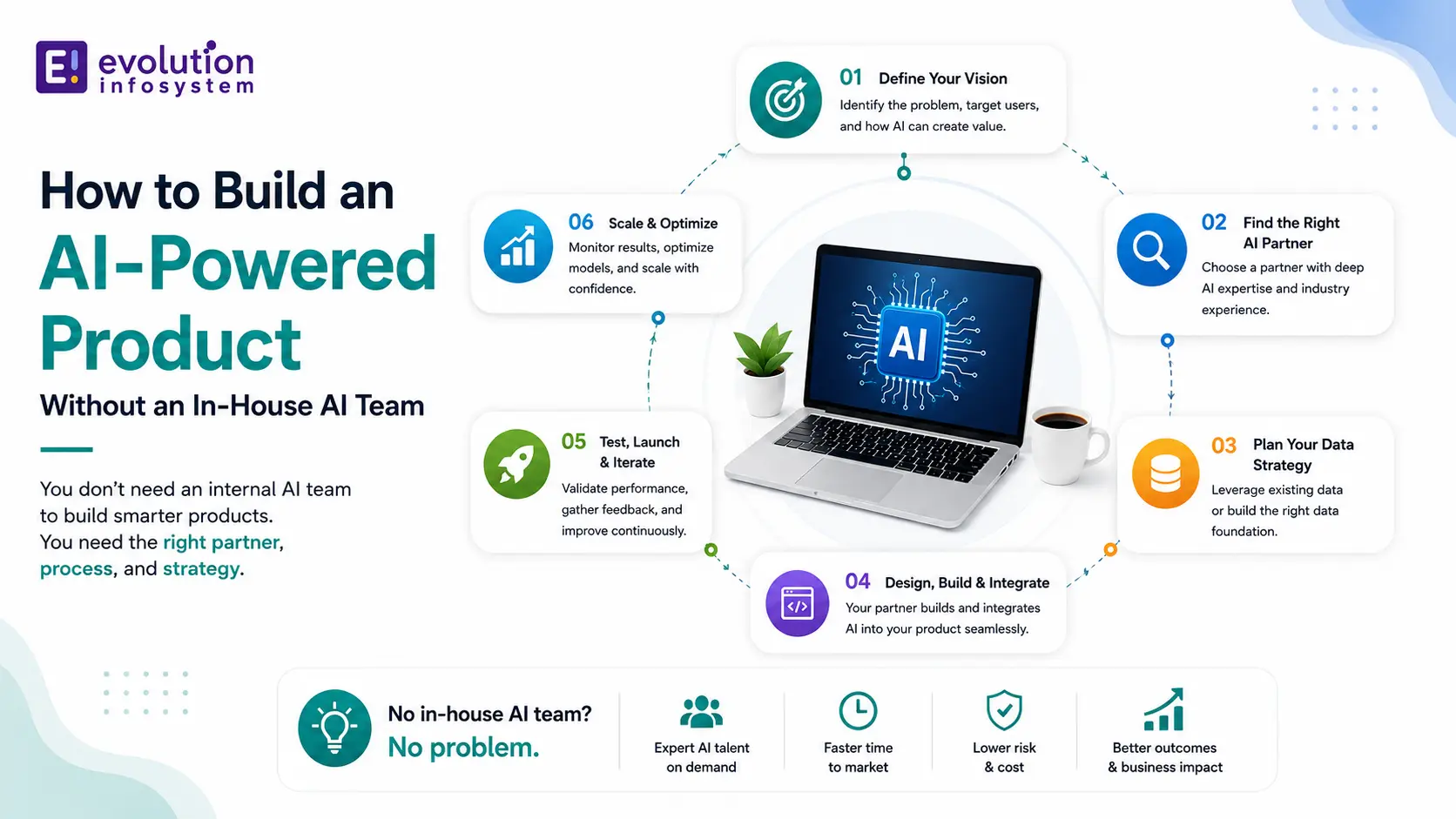
Here’s the situation most businesses are in right now. Leadership has decided AI needs to be in the product. Competitors are shipping AI features. Customers are asking about it. The board is asking about it.
The problem: you don’t have an AI engineer. You don’t have a machine learning team. You have a product roadmap that just got a lot more complicated, and no clear path to executing it.
This is not a niche situation. It’s the default situation for the vast majority of businesses trying to build with AI right now, in 2026. Hiring a full in-house AI team is slow, expensive, and largely unnecessary for most product requirements. The companies shipping AI features fastest are mostly doing it without large internal AI teams. They’re doing it by making smart decisions about what to build, how to architect it, and who to build it with.
Here’s how to do the same.
Understand What “AI in Your Product” Actually Means
Before making any build decisions, get precise about what you’re actually trying to do. “Add AI to the product” is not a specification. It’s a direction. The implementation differs enormously depending on what you mean.
Most AI product features fall into one of four categories:
→ LLM-powered generation.
Your product generates content, summaries, drafts, responses, or recommendations using a large language model. This is the most common starting point. It requires no custom model training. You call an API (OpenAI, Anthropic, Google) and work with the response.
→ Retrieval-Augmented Generation (RAG).
Your product answers questions or generates responses grounded in your own data. A knowledge base, a document library, a product catalog. The LLM doesn’t hallucinate because it’s working from your actual content, retrieved in real time. This is slightly more complex but still well within reach without in-house AI expertise.
→ AI-powered classification or prediction.
Your product makes decisions based on patterns in data. Fraud detection, churn prediction, lead scoring, demand forecasting. This is where the line between LLM-based AI and traditional machine learning starts to matter. Some of these use cases are well served by existing APIs and tools. Others genuinely need a data scientist and a training pipeline.
→ Autonomous agents.
Your product can take multi-step actions independently. Research, draft, send, schedule, update. LLM as a reasoning engine, connected to tools and APIs. This is the most powerful category and the one with the most implementation complexity.
Get clear on which category your use case falls into before building anything. The answer determines your architecture, your tooling, your timeline, and what kind of external expertise you need.
You Don’t Need to Train a Model. Almost Nobody Does.
This is the most persistent misconception about AI product development. Teams assume building an AI feature means training or fine-tuning a machine learning model. It almost never does.
Fine-tuning a model requires large volumes of high-quality labelled data, significant compute infrastructure, ML engineering expertise, and ongoing maintenance as data drifts. It’s expensive, slow, and for the majority of product use cases, completely unnecessary.
GPT-4o, Claude, and Gemini are already trained on more data than any business could realistically accumulate. They’re capable of extraordinary things out of the box. The skill is in using them correctly, not in replacing them with something custom.
For 80-90% of AI product features, the right approach is prompt engineering and RAG, not fine-tuning. Prompt engineering means carefully designing the instructions you give the model. RAG means giving the model access to your specific data at query time. Together, these two approaches produce output that is accurate, relevant, and specific to your business context, without a training pipeline anywhere in sight.
Fine-tune when you have a very specific, narrow task, high-quality labelled data at scale, and clear evidence that prompt engineering has hit a ceiling. Not before.
The Architecture Decision That Determines Everything
The most consequential early decision in building an AI-powered product isn’t which model to use. It’s how the AI component fits into the rest of your system.
Three patterns cover most production use cases:
→ Direct API integration.
Your application calls an LLM API, receives a response, and uses it. Simplest pattern. Right for single-step tasks where the model has enough context in one prompt.
→ RAG pipeline.
Your application retrieves relevant content from your data store, injects it into the prompt as context, and passes the enriched prompt to the LLM. Right when your product needs to work with your specific data. Knowledge bases, documentation, product catalogs, support histories.
→ Agentic system.
Your application uses the LLM as a reasoning engine that decides what actions to take, executes them using connected tools, evaluates results, and iterates. Right for multi-step autonomous workflows. Significantly more complex to build and maintain correctly.
Start with the simplest pattern that solves your actual problem. Teams consistently over-engineer AI integrations by jumping to agentic architectures when a direct API call with a well-crafted prompt would have done the job in a tenth of the time.
What You Actually Need Externally
Building an AI-powered product without an in-house AI team doesn’t mean building it alone. It means being smart about what expertise to bring in and when.
What a good AI development partner handles – and why each piece matters:
→ Architecture.
Which pattern fits your use case, what infrastructure it requires, how it connects to your existing systems without breaking them.
→ Prompt engineering.
This is a genuine engineering discipline. The difference between a prompt that produces reliable, high-quality output and one that produces inconsistent garbage is significant. It takes experience to get right.
→ RAG implementation.
Vector databases, embedding models, chunking strategies, retrieval ranking. There are many ways to implement RAG. Most first attempts are slow, expensive to run, and produce poor retrieval quality. Experience with production RAG systems is worth a great deal here.
→ Evaluation infrastructure.
Before you ship an AI feature, you need a way to measure whether it’s working. Eval datasets, automated scoring, regression testing when you update prompts or switch models. Teams that skip this discover problems in production, not in testing.
→ Observability.
Logging inputs, outputs, latency, and error rates per request. You cannot debug a production AI system without full trace visibility.
What you keep in-house:
→ Product decisions.
What the AI feature does, what success looks like, how it fits the user experience. Nobody outside your organization understands your users and your product well enough to own these decisions.
→ Data.
Your proprietary data is your competitive advantage in an AI-powered product. How it’s structured, cleaned, and used in your RAG pipeline matters enormously.
→ Quality review.
Human review of AI outputs, especially in early stages, catches problems before they reach users at scale. This should be an internal function.
The Build Timeline, Realistically
Teams consistently underestimate how long AI features take when they’re building for the first time, and overestimate how long they take when working with an experienced partner.
A realistic timeline for common AI product features with a capable external team:
→ Simple LLM feature (generation, summarisation, classification): 2-4 weeks including integration, testing, and deployment.
→ RAG-based knowledge or search feature: 6-10 weeks including data pipeline, vector database setup, retrieval quality tuning, and eval infrastructure.
→ Agentic workflow: 10-16 weeks for a production-grade system with proper tool integration, human-in-the-loop checkpoints, and observability. Longer for complex multi-agent architectures.
These timelines assume clear requirements, accessible data, and a team that has built production AI systems before. Requirements ambiguity and data quality problems are the two most common sources of timeline overrun. Resolve both before the build starts.
The Questions to Ask Any AI Development Partner
Not every software development company that claims AI capability has actually shipped AI features in production. The gap between “we use AI tools” and “we’ve built production AI systems” is significant.
Ask specifically:
→ What AI features have you shipped to production?
Not demos. Not prototypes. Production systems with real users.
→ How do you handle prompt versioning and regression testing?
Any team that doesn’t have a clear answer to this hasn’t operated a production LLM integration seriously.
→ How do you manage output quality over time?
LLM outputs drift as models update and as edge cases accumulate. What’s the process?
→ What’s your approach when the model hallucinating is a real risk?
The answer should involve output validation, retrieval grounding, and human review checkpoints, not just “the model is really good.“
→ Can you show me a RAG pipeline you’ve built and explain the retrieval quality tradeoffs you made?
Retrieval quality is the hardest part of RAG to get right. An experienced team has strong opinions about it.
The Bottom Line
You don’t need an in-house AI team to build an AI-powered product. You need clear thinking about what you’re actually building, the right architecture for your use case, and a development partner who has shipped AI in production and can tell you exactly why they made the decisions they made.
The businesses falling behind on AI are not the ones without internal AI teams. They’re the ones treating AI as a feature to be bolted on after the real product is built, or waiting until they’ve hired the perfect ML engineer before starting.
Start with a specific use case. Pick the simplest architecture that solves it. Find a partner who has done it before. Ship.
At Evolution Infosystem, we provide AI services for businesses that don’t have in-house AI teams. We’ve shipped LLM integrations, RAG pipelines, conversational AI interfaces, and agentic workflows across industries. We’ll tell you what your use case actually requires, not what sounds impressive. Let’s talk.
Frequently Asked Questions (FAQs)
Do I need to hire AI engineers to add AI to my product?
No. For most AI product features, the right approach is working with an experienced AI development partner who has shipped production AI systems. The use cases that genuinely require in-house ML engineering, such as custom model training at scale, are the exception, not the rule.
What is the difference between fine-tuning and prompt engineering?
Fine-tuning retrains a model on your specific data. Prompt engineering designs the instructions given to an existing model to shape its output. For most product use cases, prompt engineering combined with RAG delivers equivalent results without the cost and complexity of fine-tuning.
How long does it take to add an AI feature to an existing product?
Simple LLM features take 2-4 weeks. RAG-based features take 6-10 weeks. Agentic workflows take 10-16 weeks. These timelines assume experienced developers and clear requirements.
What is RAG, and why does it matter for AI product development?
RAG (Retrieval-Augmented Generation) is an architecture that retrieves relevant content from your data at query time and injects it into the LLM prompt as context. It allows the model to generate responses grounded in your specific data without hallucinating, and without requiring custom model training.