How to Manage a Remote Development Team Across Time Zones
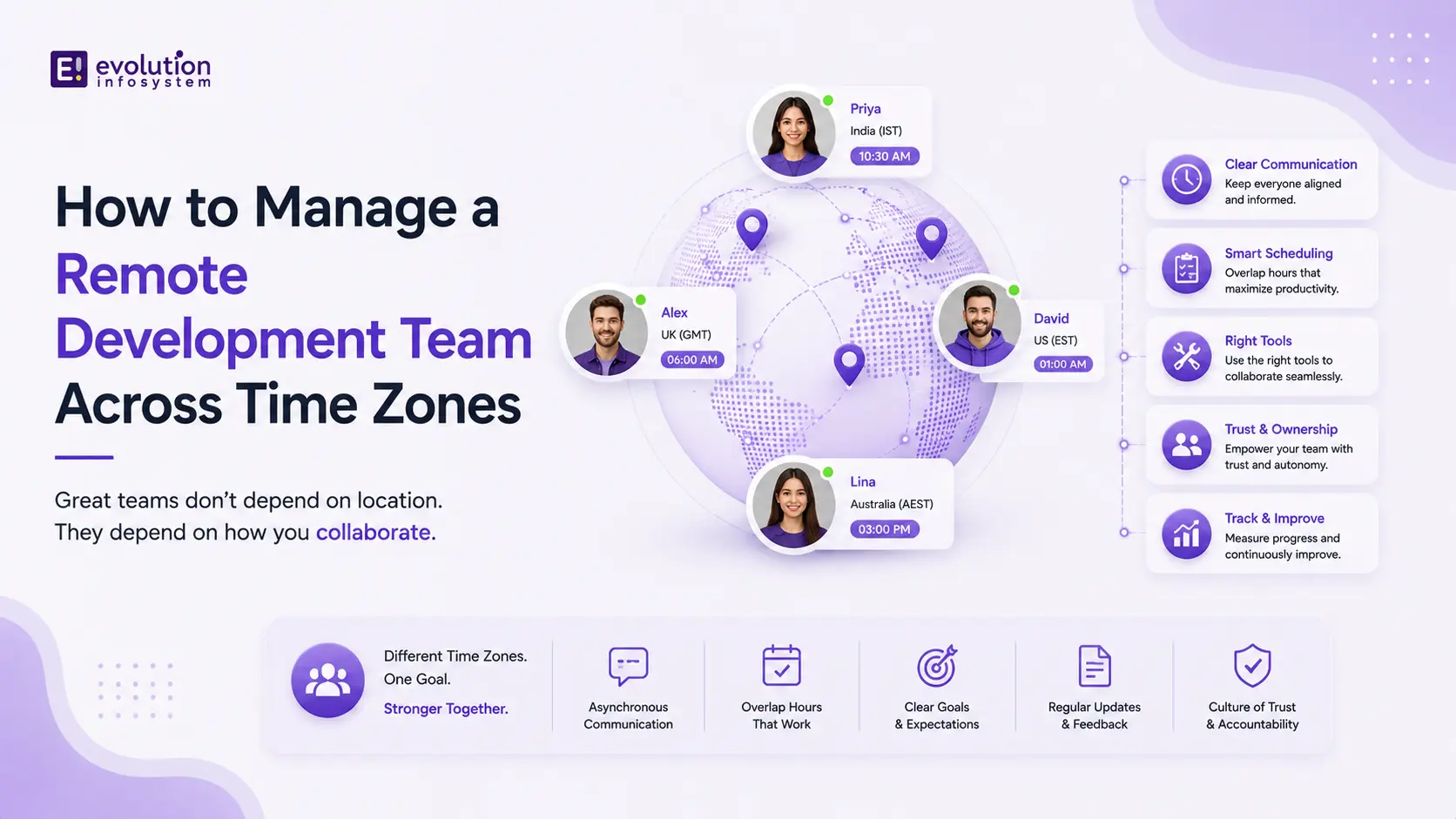
Managing a remote development team across time zones is one of the most common challenges facing growing technology companies – and one of the most frequently handled poorly.
The failure mode is consistent: companies adopt remote development for its talent and flexibility advantages, then try to manage a distributed team the same way they’d manage a co-located one. They schedule too many synchronous meetings. They create communication bottlenecks around a small number of time zones. They measure activity instead of output. And they wonder why delivery is slower than expected.
Managing distributed teams well is a discipline. It requires deliberate choices about communication, process design, tooling, and culture – not just a collection of productivity apps and a Slack workspace.
Here’s what actually works.
Design for Async First, Sync Selectively
The biggest structural mistake in distributed team management is treating asynchronous communication as a fallback when synchronous isn’t possible, rather than as the default mode of operation.
Async-first means that the default expectation is that communication happens through written, persistent channels – documented in a place everyone can access on their own schedule – and that synchronous meetings are reserved for situations that genuinely benefit from real-time interaction: complex problem-solving, decision-making with high ambiguity, relationship-building, and retrospectives.
The practical implementation:
Every decision of consequence gets documented in writing before a synchronous call happens. The call is to resolve what the document couldn’t, not to have the conversation that should have been a document. After the call, decisions and action items are documented immediately.
Stand-ups move to asynchronous format – a daily written update from each team member covering what they completed, what they’re working on, and what’s blocking them. This takes 5 minutes instead of 15, works across any time zone combination, and produces a searchable record of team activity that synchronous stand-ups never do.
Code reviews, design feedback, and technical discussions happen asynchronously in pull requests and documented threads – not in real-time calls that can’t be referenced later.
This isn’t about eliminating human interaction. It’s about preserving synchronous time for the interactions that actually need it.
Find and Protect the Overlap Window
Even in an async-first culture, some synchronous collaboration window matters – for the real-time problem-solving and relationship-building that asynchronous communication genuinely can’t replicate.
For distributed teams across significantly different time zones – US East Coast and India, for example, or UK and Southeast Asia – this overlap window is limited. Finding it requires deliberate scheduling, and protecting it requires discipline.
The rule: identify the 2–4 hour window where all time zones have reasonable working hours and protect that window ruthlessly. It’s the only time for synchronous collaboration. Don’t fill it with status updates, routine check-ins, or meetings that could be documents. Use it for architecture discussions, design reviews, sprint planning, and the high-context conversations that actually move work forward.
Outside the overlap window, every team member needs clear enough direction and sufficient decision-making authority to make progress without waiting for a synchronous clarification. Blockers that require cross-timezone input should be escalated through documented channels with a clear SLA for response – not held until the next overlap window by default.
Write Everything Down – Seriously
Distributed teams live or die by their documentation quality. In a co-located environment, context travels through hallway conversations, over-the-shoulder explanations, and informal team interactions. None of that exists across time zones. Documentation is the only mechanism that replaces it.
This means:
→ Architecture Decision Records (ADRs).
Every significant technical decision – why a particular approach was chosen, what alternatives were considered, and what constraints drove the decision – gets documented in a standard format accessible to the whole team. New team members understand the codebase’s design history. Revisiting past decisions doesn’t require hunting down the people who made them.
→ Runbooks.
Every operational procedure – deployment steps, incident response processes, environment setup – documented clearly enough that any team member can execute it without asking for help. This is especially critical for teams spanning time zones where the person who originally wrote a process may be asleep when someone else needs to follow it.
→ Project context documents.
Each significant piece of work gets a brief written context document: what it is, why it matters, what the constraints are, and how it relates to other work in flight. This eliminates the “I need to get on a call to explain this” dynamic that creates bottlenecks in distributed teams.
The test for documentation quality: can a new team member in a completely different time zone from the rest of the team become productive in their first week using only your written documentation? If the answer is no, your documentation isn’t adequate for distributed work.
Define Output Metrics, Not Activity Metrics
The impulse to monitor activity – online status, message frequency, hours logged – is understandable in distributed teams where you can’t physically see people working. It’s also counterproductive.
Activity metrics measure presence, not contribution. A developer who is online for 9 hours, attends every meeting, and responds to every message quickly may be delivering very little. A developer who is online for 6 hours, keeps communication focused and efficient, and ships clean, well-tested code consistently is delivering a great deal.
What to measure instead:
→ Delivery velocity.
Story points, features shipped, pull requests merged per sprint. Tracked consistently over time, delivery velocity reveals trends – both positive (improving as the team matures) and concerning (declining without explanation) – that activity metrics never surface.
→ Code quality indicators.
Bug rate, test coverage, review turnaround time, and technical debt accumulation are measurable output quality signals that matter far more than whether someone was online at 9am.
→ Cycle time.
How long does work take from start to completion? Distributed teams often have longer cycle times due to review and feedback latency across time zones. Tracking cycle time makes this visible and creates the pressure to design processes that reduce it.
→ Outcome-based OKRs.
Every team member and team unit should have clear outcomes they own – not tasks, outcomes. What impact will this person’s work have on the product and the business in the next quarter? That question, answered clearly and revisited regularly, orients distributed team members toward what matters rather than toward looking busy.
Build Culture Intentionally
Culture in a co-located team forms organically through shared physical space, informal interaction, and accumulated shared experience. None of that happens automatically in a distributed team. It has to be designed.
Practically:
→ Structured informal interaction.
Virtual coffee chats, non-work chat channels, team game sessions, and regular informal video calls – scheduled, not left to chance. These feel slightly contrived at first. They matter more than most managers expect for team cohesion and trust.
→ Celebration and recognition.
In co-located teams, a shipped feature or a solved hard problem gets visible acknowledgment. In distributed teams, that recognition has to be explicit and public in shared channels. The absence of it is louder in a remote context than it would be in person.
→ Regular retrospectives.
Not just on technical delivery, but on how the team is working together. What communication patterns are creating friction? What processes are working well? Distributed teams that run honest retrospectives on their ways of working improve continuously. Those that don’t accumulate friction silently until it surfaces as turnover or delivery problems.
→ Periodic in-person gatherings.
For teams that are truly globally distributed, annual or semi-annual in-person gatherings are disproportionately valuable for relationships and trust that sustain asynchronous collaboration over the rest of the year. The investment in a team gathering pays back in reduced friction, improved communication quality, and retention.
The Tools That Actually Matter
Tool choices matter less than process design, but the right tools reduce friction significantly.
Today, the distributed development stack that works:
→ Communication: Slack or Microsoft Teams for async messaging. Linear threading is non-negotiable for distributed teams – conversations without threads become noise.
→ Documentation: Notion or Confluence for persistent knowledge. GitHub for code-level documentation. Decision logs in the repository itself.
→ Project management: Linear or Jira for engineering work. Clear ticket structure, explicit acceptance criteria, and visible sprint progress that doesn’t require a synchronous status update to interpret.
→ Code collaboration: GitHub or GitLab with clear branch strategies, pull request templates, and automated CI/CD that reduces the human review surface to what actually requires human judgment.
→ Async video: Loom for walkthroughs, demos, and complex explanations that benefit from visual and audio context but don’t require a live audience.
At Evolution Infosystem, we operate as a distributed team serving clients globally – across the US, UK, Europe, Southeast Asia, and beyond. We’ve built the async-first processes, documentation culture, and overlap window management that let us deliver at the same standard as co-located teams. If you’re working with a distributed development partner or building your own remote engineering function, let’s talk.
Frequently Asked Questions (FAQs)
How do you manage a development team across multiple time zones?
Design for async-first communication, identify and protect a synchronous overlap window for high-context collaboration, document everything, measure output rather than activity, and build culture intentionally through structured informal interaction and regular retrospectives.
What is the biggest challenge of managing a remote development team?
Communication latency and the absence of informal context-sharing are the most cited challenges. The practical solution is a documentation-first culture – ensuring that context, decisions, and project information are written down and accessible asynchronously rather than held in individuals’ heads or shared only in synchronous calls.
What tools are best for managing a distributed development team?
Slack or Teams for async messaging (with Linear threading), Notion or Confluence for documentation, Linear or Jira for project management, GitHub or GitLab for code collaboration, and Loom for async video communication. Tools are secondary to process design – the same tools produce very different results depending on how they’re used.
How much time zone overlap do distributed teams need?
A minimum of 2 hours of working-hours overlap per day is the practical floor for maintaining synchronous collaboration. Less than this requires a very mature async-first culture to compensate. More than 4 hours of overlap is rarely necessary if asynchronous processes are well-designed.
Let’s Build: Evolution Infosystem provides staff augmentation, dedicated development teams, and extended team services globally – with distributed team management processes built in. Contact us to discuss your team scaling requirements.