Staff Augmentation vs. Dedicated Team vs. Extended Team: Which Model Is Right for Your Business?
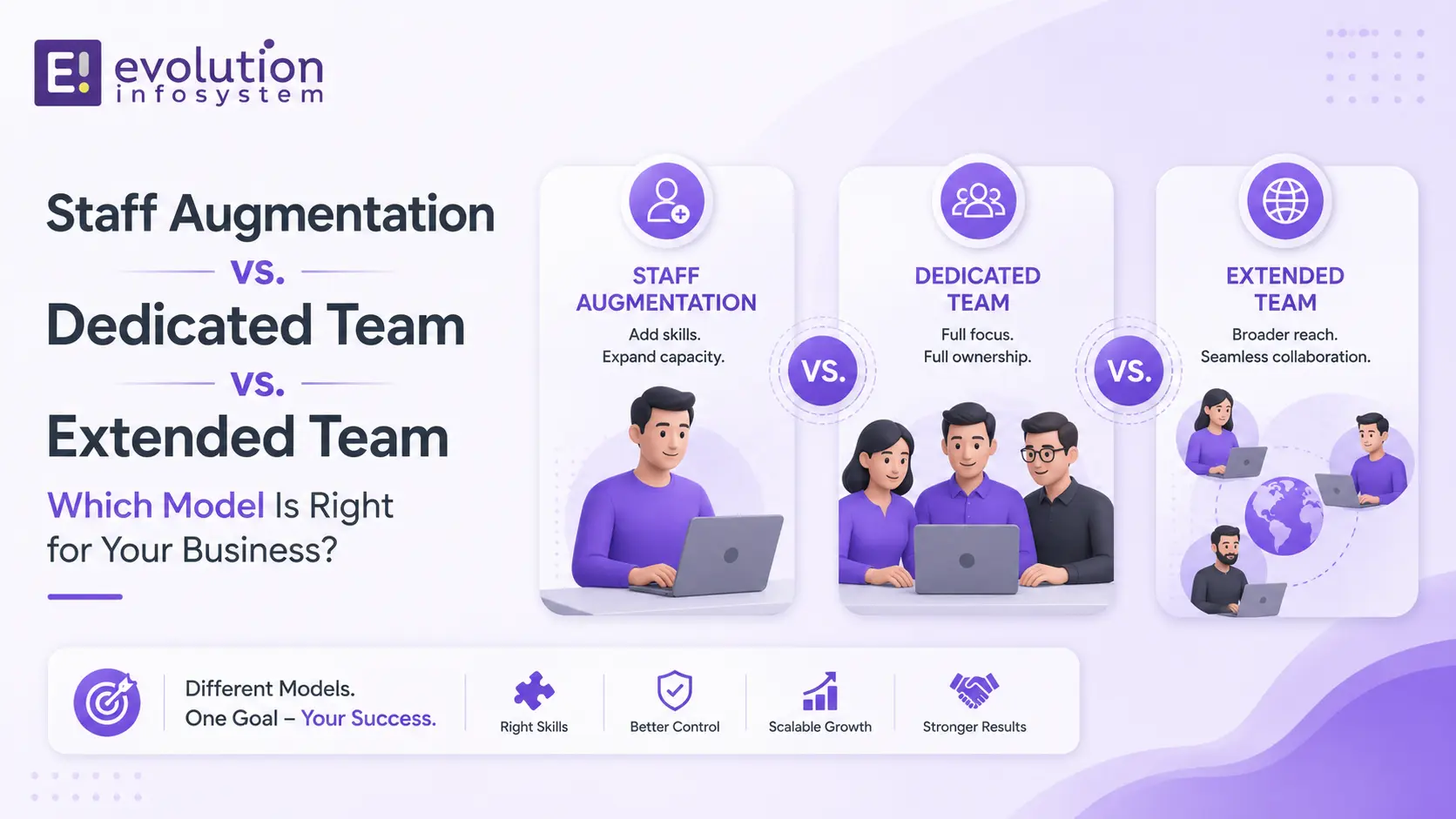
Scaling your tech team is one of the most critical decisions a growing business makes. Get it wrong, and you’re burning budget, slowing delivery, and managing people you don’t have time to manage. Get it right, and you move faster, build better, and stay lean where it counts.
Three engagement models dominate the software development outsourcing landscape in 2026: staff augmentation, dedicated development teams, and extended teams. They sound similar. They are not. And picking the wrong one for your stage, budget, and goals is one of the most common and expensive mistakes businesses make.
This guide gives you a clear breakdown of all three, so you can make the right call.
What Is Staff Augmentation?
Staff augmentation is the practice of hiring external developers or specialists to work directly within your existing in-house team. You retain full management control. The augmented professionals follow your workflows, use your tools, and report to your leadership – just like internal employees, but without the overhead of permanent hiring.
IT staff augmentation is essentially on-demand talent. You identify the skill gap, source the right people, plug them in, and direct the work yourself.
When Staff Augmentation Works Best
- You have a well-defined, short-to-medium-term project (under 6 months)
- You need a specific technical skill – React Native, DevOps, AI/ML, QA – that your team lacks
- You have a strong internal tech lead or CTO who can absorb management overhead
- Speed of deployment matters more than long-term team stability
- You want to scale tech team capacity without committing to permanent headcount
Advantages of Staff Augmentation
- Fast deployment. Augmented developers can be onboarded in days to weeks.
- Full control. You manage the work, the priorities, and the timeline.
- Flexibility. Scale up or down as project demands change.
- Cost efficiency. No long-term employment costs, benefits, or redundancy risk.
The Real Limitations
Staff augmentation puts the coordination load squarely on you. If your internal management bandwidth is already maxed out, adding external developers creates more noise than output. You’re also exposed to high turnover – tech contractor churn rates run between 30–40% annually, meaning lost context and re-onboarding costs every time someone rotates off.
What Is a Dedicated Development Team?
A dedicated development team is a fully assembled, self-managed unit built specifically around your product goals. Rather than individual contractors slotting into your team, you get a cohesive group – typically including developers across front-end and back-end, a QA engineer, a project manager, and often a tech lead or solution architect – all working exclusively on your project.
The key distinction from staff augmentation: you’re not managing individuals. You’re working with a team that manages itself.
When a Dedicated Development Team Works Best
- You’re building or scaling a core product with a long roadmap (6+ months)
- You don’t have (or don’t want to build) an internal tech team from scratch
- You need cross-functional collaboration across multiple roles, not just raw coding capacity
- Deep domain knowledge and product continuity are critical to delivery quality
- You’re a startup building an MVP or a growing business launching a new digital product
Advantages of a Dedicated Team Model
- Built-in accountability. The team owns delivery, not just tasks.
- Product-level knowledge. Continuity means developers understand your codebase and business context deeply over time.
- Less management overhead. You set direction and review outcomes. The team handles execution.
- Predictable cost structure. Fixed monthly engagement removes the unpredictability of hourly billing.
The Real Limitations
A dedicated development team takes longer to spin up than staff augmentation (typically 2–4 weeks). If your requirements shift radically every few weeks or you need to move fast in a single sprint, this structure can feel rigid. It’s also a bigger upfront commitment, so if your scope isn’t clear, you risk paying for capacity that isn’t fully utilized.
What Is an Extended Team?
The extended team model is a hybrid that sits between staff augmentation and a fully dedicated team. You’re building a remote development team that functions as a genuine branch of your organization. They’re deeply integrated into your culture, communication systems, workflows, and strategic direction – but geographically distributed.
Unlike staff augmentation, which is typically project-specific and temporary, an extended team is a long-term strategic asset. Unlike a dedicated team, which operates with a degree of independence, an extended team is fully absorbed into your company’s operational identity.
When the Extended Team Model Works Best
- You want to build long-term, scalable tech capacity without the cost and risk of full-time local hiring
- Cultural and operational alignment matters as much as technical output
- You’re expanding globally and need a regional development presence
- You have documented internal processes and a clear product vision that the remote team can plug into
- Your current roadmap extends 12+ months and requires a stable, growing team
Advantages of an Extended Team
- Strategic continuity. This isn’t temporary support. It’s a permanent extension of your business.
- Scalability. Add or adjust roles as your business grows without the friction of local hiring.
- Cultural integration. Done right, an extended team thinks and operates like an internal team, not a vendor.
- Global talent access. Tap specialized skills from high-quality tech markets at competitive rates.
The Real Limitations
This model requires investment in onboarding, culture-building, and structured knowledge transfer. It’s not plug-and-play. If you don’t have clear internal processes or a defined product vision, an extended team will lack direction. The longer ramp-up time (4–8 weeks typically) means it’s not the right tool for urgent, short-horizon needs.
Staff Augmentation vs. Dedicated Team vs. Extended Team: Side-by-Side Comparison
| Factor | Staff Augmentation | Dedicated Development Team | Extended Team |
|---|---|---|---|
| Management | Client manages | Vendor manages | Co-managed |
| Time to Deploy | Days to 2 weeks | 2–4 weeks | 4–8 weeks |
| Engagement Length | Short-term | Medium to long-term | Long-term |
| Cost Model | Pay per resource/hour | Fixed monthly retainer | Structured long-term retainer |
| Cultural Integration | Low | Medium | High |
| Flexibility | High | Medium | Low–Medium |
| Team Accountability | Client-side | Vendor-side | Shared |
| Best Fit | Skill gap, defined task | Product builds, startups | Business expansion, scale |
| Talent Access | Specific roles | Full cross-functional team | Strategic long-term capability |
How to Choose the Right Model for Your Business
Ask yourself three questions. The answers make the decision obvious.
1. How long do you need this capacity?
- Under 6 months with a defined scope: Staff augmentation. Fast, flexible, and light on commitment.
- 6–18 months with an evolving product roadmap: Dedicated development team. You need continuity and ownership, not just capacity.
- 12+ months as a core business capability: Extended team. You’re not outsourcing a project. You’re scaling a function.
2. How much internal management bandwidth do you have?
If you have a strong CTO or tech lead with time to direct and review external work, staff augmentation is manageable. If your internal leadership is already stretched, stop and get a dedicated team that manages itself. Expecting over-burdened internal managers to effectively direct 5+ external developers across time zones is how projects fall apart.
3. Is this a project or a capability?
- One-time build or a defined deliverable: Dedicated development team.
- Ongoing capability that should feel like part of your company: Extended team.
Why Businesses Get This Wrong (And How to Avoid It)
The most common mistake: companies default to staff augmentation because it feels low-commitment. Then they end up managing 6 external developers scattered across time zones, with no unified accountability, fragmented communication, and a codebase no single person fully owns.
The second most common mistake: companies jump into a dedicated team engagement without clearly defining success at 30, 60, and 90 days. A dedicated team without a clear brief is an expensive placeholder.
The root cause in both cases is the same. Businesses choose a model based on what sounds easy or affordable in the short term, rather than what fits their actual operational stage and project reality.
Choosing the right software development outsourcing model isn’t just about cost. It’s about how much management capacity you have, how long your roadmap runs, and how much product ownership you can afford to delegate.
Staff Augmentation vs. Dedicated Team: Which Scales Faster?
If you measure speed purely as “bodies on the ground,” staff augmentation wins sprint one. But software delivery is a marathon of accumulated context. Once your engagement extends beyond two quarters or your team needs exceed a dozen people, the cohesion advantage of a dedicated development team compounds throughput, reduces attrition risk, and cuts the cost of knowledge loss.
Staff augmentation is your tactical response force. Dedicated teams are your strategic scaling engine. The smartest businesses often start with augmentation for critical early sprints, then transition high-performing individuals into a dedicated or extended team model as the roadmap stabilizes.
How Evolution Infosystem Helps You Scale the Right Way
At Evolution Infosystem, we don’t push one model because it’s easier for us to sell. We ask the hard questions first:
- What does your current team look like?
- What’s the actual bottleneck – skill, capacity, or direction?
- What does your roadmap look like in 6 and 12 months?
Then we match the engagement model to what your business actually needs.
We operate across all three models:
- IT Staff Augmentation – for fast skill-gap coverage and short-term project support
- Dedicated Development Teams – for product-focused builds, MVPs, and long-horizon delivery
- Extended Teams – for businesses serious about building scalable remote tech capacity as a strategic function
Our clients are startups and enterprises across the US, UK, Europe, Southeast Asia, and beyond. We’ve built AI-powered platforms, enterprise SaaS products, mobile apps, IoT systems, and custom automation solutions – all under the engagement model that fits.
The outcome we care about isn’t just delivery. It’s whether you move faster, build better, and carry less operational risk after working with us.
Ready to figure out which model fits where you are right now? Let’s talk.
Frequently Asked Questions (FAQs)
What is the difference between staff augmentation and a dedicated team?
Staff augmentation adds individual developers to your existing team under your management. A dedicated development team is a fully assembled, self-managed group that takes ownership of delivery. The key difference is management responsibility – with augmentation, it stays with you; with a dedicated team, it transfers to the vendor.
When should I choose staff augmentation over a dedicated team?
Choose staff augmentation when you have a well-defined, short-term project (under 6 months), a specific skill gap to fill, and the internal management capacity to direct external talent. Choose a dedicated team when your project runs 6+ months, requires cross-functional collaboration, and you want a team that owns delivery rather than just executing tasks.
What is an extended team model in software development?
An extended team is a remote development team that is deeply integrated into your company’s culture, workflows, and strategic direction over the long term. It functions as a permanent branch of your organization rather than a temporary vendor engagement. It’s best suited for businesses scaling their tech capability as a core business function.
Is staff augmentation the same as outsourcing?
Not exactly. Staff augmentation is a form of outsourcing, but in staff augmentation, you retain management control over the individuals. Traditional project outsourcing delegates full delivery responsibility to the vendor. A dedicated team model sits between the two – the vendor manages the team, but you set direction and priorities.
Let’s Build: Evolution Infosystem is an AI-driven software development company offering staff augmentation, dedicated development teams, and extended team services globally. We specialize in AI, automation, custom web and mobile development, LLM integration, IoT, QA, and enterprise software. Contact us to discuss which model fits your business.