What is REST API and How Does It Work: The Ultimate Guide from Evolution Infosystem
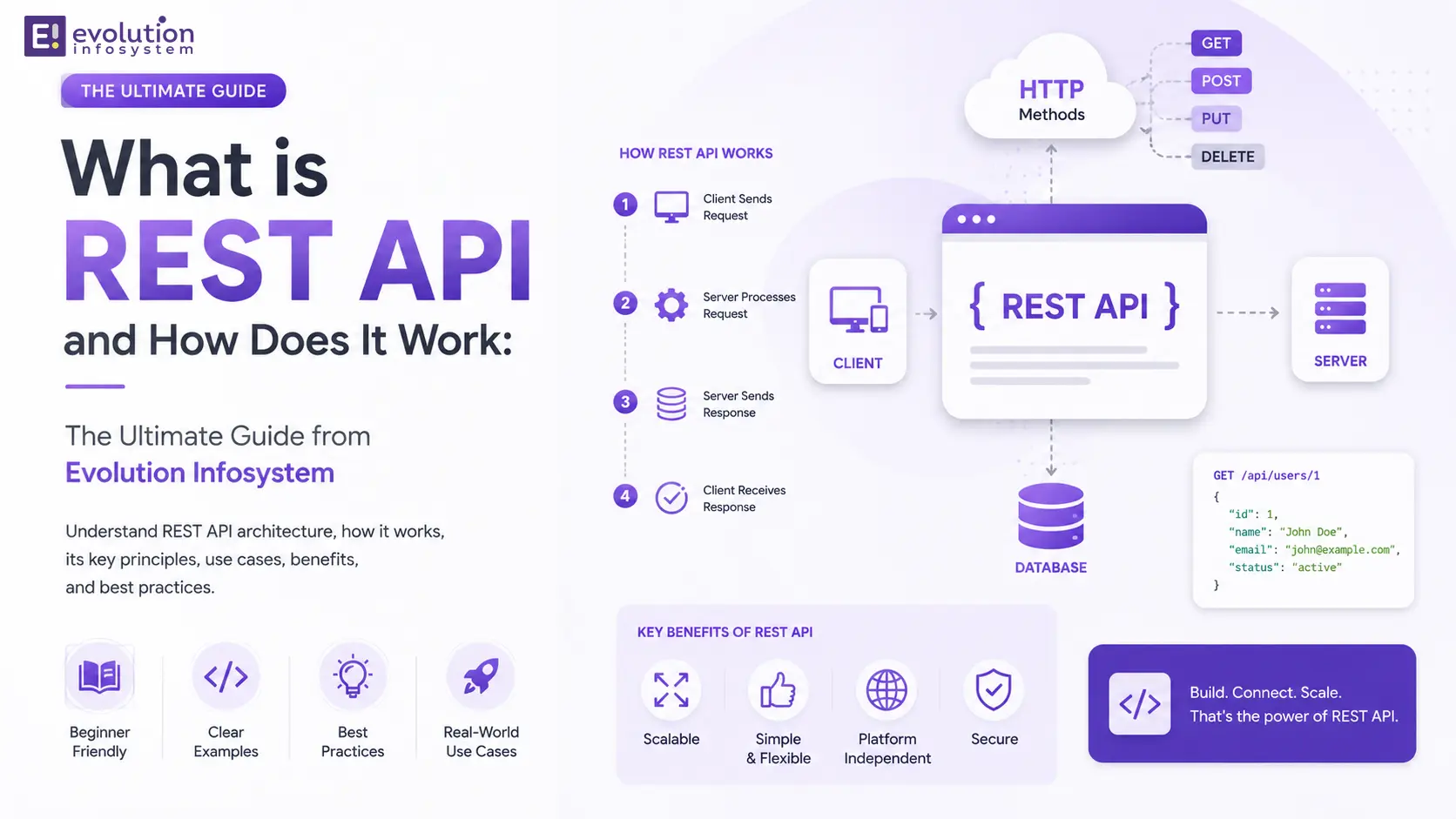
Have you ever wondered how your favorite apps, like banking tools, social platforms, or e-commerce sites, seamlessly pull data from servers and update in real-time? The answer often lies in a powerful technology called REST API. At Evolution Infosystem, we’ve helped countless businesses harness REST API to create connected, efficient digital experiences.
In this comprehensive REST API tutorial, we’ll explore what a REST API is, how REST API works, its core REST API principles, practical examples, and advanced tips. Whether you’re a developer, business owner, or tech enthusiast, you’ll gain actionable insights to build or integrate robust systems. Let’s dive in and demystify this cornerstone of modern web development.
Introduction to REST API: Connecting the Digital World
REST API stands for Representational State Transfer Application Programming Interface. It’s not just a tool-it’s an architectural style that enables different software systems to communicate over the web using standard protocols, primarily HTTP.
Think of a REST API like a restaurant menu and waiter system. The client (you, the diner) places an order using clear language (the request). The kitchen (server) prepares and delivers exactly what’s asked for (the response), without remembering your previous visits (stateless). This simplicity makes RESTful API designs incredibly scalable and reliable.
At Evolution Infosystem, we specialize in crafting custom REST API solutions as part of our custom software development and AI integration services. We’ve seen firsthand how mastering how the REST API works transforms businesses, enabling everything from mobile app backends to enterprise ERP systems.
Why does this matter today? With the API economy booming and organizations increasingly going API-first, understanding REST API is essential. Recent data shows 82% of organizations have adopted some level of an API-first approach, with REST dominating at 93% of API styles.
The Challenges Developers and Businesses Face Without Effective APIs
Before diving deeper into REST API principles, let’s acknowledge the problem. Traditional integration methods-like direct database connections or rigid protocols-often lead to tight coupling, scalability nightmares, and security vulnerabilities.
Imagine building a mobile app that needs real-time user data, payment processing, and inventory checks from different systems. Without a well-designed REST API, you’d face constant headaches: slow performance, version conflicts, and maintenance overload. Many teams waste hours troubleshooting incompatible systems.
This is where RESTful API shines. It solves these pain points by providing a standardized, flexible way for applications to interact. Businesses using proper REST API report better developer productivity, faster time-to-market, and new revenue streams. In fact, many organizations now generate significant revenue directly from their APIs.
At Evolution Infosystem, we’ve helped clients overcome these challenges by designing REST API architectures tailored to their needs, whether for cloud migration or microservices.
The Origins of REST: Roy Fielding’s Revolutionary Idea
To truly understand what a REST API is, we need to go back to its roots. The term REST was coined by computer scientist Roy Fielding in his 2000 doctoral dissertation titled “Architectural Styles and the Design of Network-based Software Architectures.”
Fielding, who contributed to HTTP specifications, sought a way to make the web more scalable for distributed hypermedia systems. His vision emphasized simplicity, statelessness, and uniformity-qualities that make REST API ideal for the internet’s anarchic scalability.
Since 2000, REST API has become the de facto standard. It’s not a protocol or strict specification but a set of guiding principles that developers implement flexibly, often with JSON for lightweight data exchange.
Core REST API Principles: The Six Architectural Constraints
The foundation of any RESTful API rests on six key constraints. These REST API principles ensure systems are scalable, maintainable, and independent.
Client-Server Architecture
This principle separates the user interface (client) from the data storage and processing (server). The client doesn’t need to know server internals, and the server doesn’t care about the client’s UI. This decoupling allows independent evolution, perfect for modern apps where mobile clients interact with cloud servers.
How REST API works here: Your phone app sends a request; the server responds without storing client-specific session data on its end.
Stateless Communication
Every request to a REST API must contain all the information needed to process it. The server doesn’t remember previous requests (no sessions stored server-side). This makes REST API highly scalable, as any server instance can handle any request.
Analogy time: It’s like sending a complete package with instructions each time instead of relying on an ongoing conversation.
Cacheability
Responses from a REST API should indicate whether they can be cached. Well-designed caching improves performance dramatically by reducing server load for repeated requests, like fetching popular product data.
Uniform Interface
This is perhaps the most important REST API principle. It includes:
- Identification of resources: Everything is a resource (e.g., /users/123).
- Manipulation through representations: Clients receive and send representations (usually JSON) to modify resources.
- Self-descriptive messages: Messages include enough info to process them.
- Hypermedia as the Engine of Application State (HATEOAS): Ideally, responses include links for further actions, though not always strictly followed in practice.
Layered System
REST API allows layered architecture (load balancers, proxies, caches) where clients interact only with the immediate layer. This enhances scalability and security.
Code on Demand (Optional)
Servers can send executable code (like JavaScript) to clients to extend functionality, though this is less commonly used today.
Checklist for REST API Principles Compliance:
- Does every request include all necessary data? (Stateless)
- Are resources identified by clean URIs?
- Do responses use standard HTTP methods and codes?
- Is caching properly implemented where beneficial?
Following these turns a basic API into a true RESTful API.
How Does REST API Work? A Step-by-Step Breakdown
Now, the core question: How does a REST API work in practice?
- Client Makes a Request: Using HTTP, the client targets a specific resource via URI (e.g., GET https://api.example.com/users/123).
- Server Processes the Request: The server authenticates, fetches or modifies data, and prepares a response.
- Server Sends Response: Includes status code, headers, and body (usually JSON).
This stateless, resource-oriented model keeps things simple and efficient.
Resources and URIs in REST API
In REST API, the focus is on resources-nouns like users, products, or orders. URIs uniquely identify them:
- /posts (collection)
- /posts/42 (specific resource)
This noun-focused approach is a hallmark of good REST API tutorial examples.
HTTP Methods: The Verbs of RESTful API
REST API leverages standard HTTP methods:
- GET: Retrieve a resource (safe, idempotent).
- POST: Create a new resource.
- PUT: Update or replace a resource (idempotent).
- DELETE: Remove a resource.
- PATCH: Partial update.
For example, in an e-commerce REST API:
- GET /products → List products
- POST /orders → Create order
- PUT /users/123 → Update user profile
Using these correctly is fundamental to how REST API works.
Data Representations and Status Codes
Responses typically use JSON for its lightness. Status codes tell the story:
- 200 OK: Success
- 201 Created: New resource made
- 400 Bad Request: Client error
- 404: Not Found
- 500: Internal Server Error
A well-crafted REST API uses these to communicate clearly without extra parsing.
REST API vs. Other Styles: SOAP, GraphQL, and More
REST API isn’t the only option. SOAP is protocol-heavy with XML envelopes, great for enterprise security but verbose. GraphQL offers flexible queries from a single endpoint, reducing over-fetching but adding complexity in caching and versioning.
When to choose RESTful API:
- For public APIs needing simplicity and caching.
- When standard HTTP semantics suffice.
- For resource-oriented systems.
Many teams use a mix. At Evolution Infosystem, we evaluate client needs before recommending REST API, GraphQL, or hybrids for optimal results.
Real-World REST API Examples and Case Studies
Popular services showcase excellent REST API design:
- Stripe: Their payment REST API uses clean endpoints like /v1/charges with predictable responses. Developers love its clarity and reliability.
- GitHub: The GitHub REST API powers millions of integrations with endpoints for repos, issues, and more, complete with excellent documentation and pagination.
Case Study: Evolution Infosystem Client Success
One of our e-commerce clients needed seamless integration between their website, mobile app, and inventory system. We built a custom RESTful API using Node.js and Express.
Results? 40% faster load times, real-time sync, and easier third-party integrations. The REST API handled thousands of daily requests reliably.
We’ve delivered similar wins across industries through our REST API development and integration expertise.
REST API Tutorial: Building Your First RESTful API Step-by-Step
Ready to get hands-on? Here’s a practical REST API tutorial using Node.js and Express (popular choices for quick starts).
Prerequisites: Basic JavaScript knowledge, Node.js installed.
1. Setup Project: mkdir my-rest-api && cd my-rest-api && npm init -y && npm install express
2. Create Server:
3. JavaScript

const express = require('express');
const app = express();
app.use(express.json());

let users = []; // In-memory "database"

// GET all users
app.get('/users', (req, res) => {
  res.json(users);
});

// POST new user
app.post('/users', (req, res) => {
  const user = req.body;
  users.push(user);
  res.status(201).json(user);
});

4. app.listen(3000, () => console.log('REST API running on port 3000'));
5. Test with Tools: Use Postman or curl to hit endpoints.
6. Add Features: Implement proper error handling, authentication (JWT/OAuth), database (MongoDB/PostgreSQL), and validation.
This basic REST API tutorial gets you started. For production, add versioning (/v1/users), pagination, and rate limiting.
Evolution Infosystem offers full custom API development services if you need expert help scaling beyond basics.
Best Practices for Designing High-Quality RESTful APIs
Creating a great REST API goes beyond basics:
- Use plural nouns for collections (/articles).
- Implement consistent error formats.
- Support filtering, sorting, and searching (e.g., /users?role=admin).
- Version your API (URL: /v1/, or headers).
- Document thoroughly with OpenAPI/Swagger.
Actionable Checklist for REST API Design:
- Resources use meaningful, hierarchical URIs.
- HTTP methods match actions appropriately.
- Responses include relevant links (HATEOAS where feasible).
- Security and performance are prioritized from day one.
Following these practices, as we do at Evolution Infosystem, leads to maintainable, developer-friendly RESTful APIs.
Advanced Tips: Security, Scaling, and Optimization for REST API
Security Best Practices:
- Always use HTTPS.
- Implement OAuth 2.0 or JWT for authentication.
- Rate limiting to prevent abuse.
- Input validation and sanitization.
- Proper logging and monitoring.
Scaling a REST API:
- Use caching layers (Redis).
- Load balancing and horizontal scaling.
- Asynchronous processing for heavy tasks.
- Microservices architecture where REST API glues services.
In cloud environments, tools like AWS API Gateway complement REST API designs.
We’ve optimized numerous REST API systems for high traffic at Evolution Infosystem, ensuring they handle growth effortlessly.
Common Mistakes to Avoid in REST API Development
Even experienced developers slip up:
- Treating REST API like RPC (using POST for everything).
- Ignoring idempotency.
- Poor error messages that leak sensitive info.
- No versioning strategy, leading to breaking changes.
- Over-fetching data without proper filtering.
Avoid these by reviewing designs against core REST API principles regularly.
The Future of REST API in AI, Microservices, and Beyond
REST API remains dominant even as AI and event-driven architectures rise. Trends include better support for AI agents as consumers, enhanced security for machine-to-machine calls, and hybrid approaches with GraphQL or gRPC.
At Evolution Infosystem, we’re integrating REST API with AI models, LLMs, and cloud solutions to future-proof client systems.
Conclusion: Master REST API and Transform Your Digital Presence
Understanding what a REST API is and how it works equips you to build connected, scalable applications that drive business value. From core REST API principles to practical implementation, the power lies in its simplicity and flexibility.
At Evolution Infosystem, our team excels at turning these concepts into real-world solutions. Whether you need a custom RESTful API, full-stack development, or AI-enhanced integrations, we’re here to help you succeed.
Ready to build or optimize your REST API?
Visit https://www.evolutioninfosystem.com/ today, explore our services, or contact us for a consultation. Let’s create something extraordinary together.
FAQs About REST API
1. What is the difference between REST API and RESTful API?
A REST API follows the REST architectural style to varying degrees. A RESTful API strictly adheres to all or most of the six REST API principles, making it fully compliant with Fielding’s vision.
2. How do you secure a REST API effectively?
Use HTTPS, strong authentication (OAuth/JWT), rate limiting, input validation, and regular security audits. Tools like API gateways add extra protection. Evolution Infosystem specializes in secure REST API implementations.
3. Is REST API still relevant with GraphQL available?
Absolutely. REST API excels in caching, simplicity for public APIs, and standard HTTP usage. Many projects use both depending on needs-REST for external interfaces, GraphQL for complex internal queries.
4. What tools are best for testing and documenting a REST API?
Postman or Insomnia for testing, Swagger/OpenAPI for documentation. These streamline development and collaboration.
5. How long does it typically take to build a production-ready REST API?
It varies by complexity-from days for simple ones to weeks or months for enterprise-scale with authentication, databases, and scaling. Partnering with experts like Evolution Infosystem accelerates the process while ensuring quality.