Custom ERP vs SAP/Oracle: What's the Real Difference in 2026?
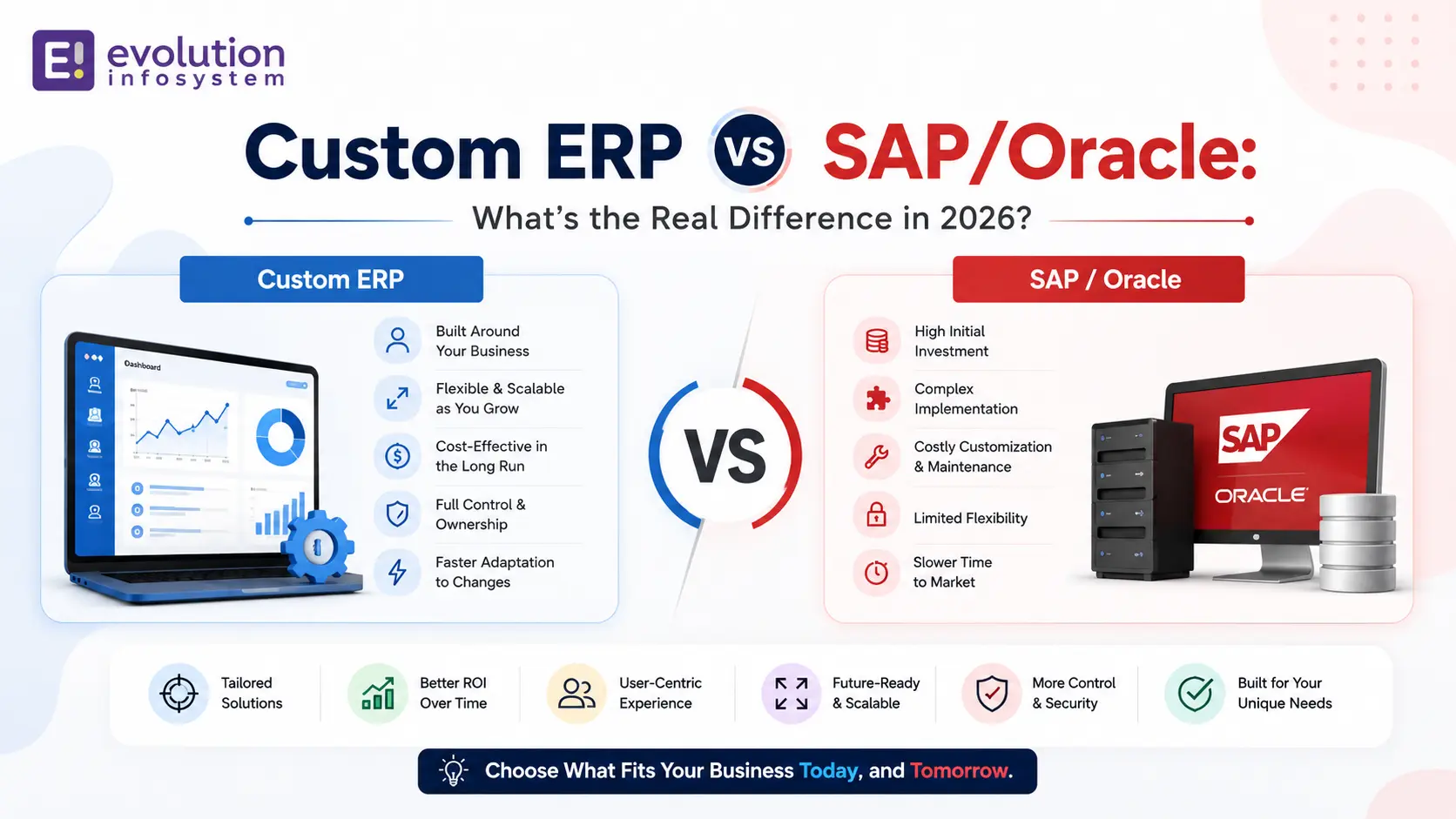
When a growing business outgrows spreadsheets and Tally, the first names that usually come up are SAP and Oracle. They’re the safe, well-known choice – but “well-known” and “right for your business” are not the same thing. This guide breaks down what actually separates custom ERP development from SAP and Oracle’s platforms, where each genuinely wins, and how to think about the decision without getting lost in vendor marketing.
The Short Answer
SAP and Oracle sell pre-built ERP software designed to work across thousands of different businesses, configured to fit your operations through parameters, add-ons, and – when needed – customization layered on top of a fixed core. Custom ERP development means building software from the ground up (or on an open-source base) specifically around how your business actually works, with no vendor licensing fees and no pre-existing structure to configure around.
Neither is universally better. SAP and Oracle win on out-of-the-box breadth, established support ecosystems, and predictability for businesses with fairly standard processes. Custom ERP wins on long-term cost control, precise fit to unusual workflows, and full ownership of the resulting system. The right choice depends entirely on how “standard” your business actually is.
What SAP and Oracle Actually Offer
It helps to be precise here, since both vendors sell several different products aimed at different business sizes.
SAP offers SAP Business One for smaller companies, SAP Business ByDesign for small-to-midsize businesses, and SAP S/4HANA for large enterprises. S/4HANA is SAP’s flagship – built for organizations with complex, global operations across manufacturing, logistics, and finance, and known for being deeply tailorable to specific industries at a cost.
Oracle offers two distinct ERP lines: Oracle NetSuite, a cloud-native platform for small, midsize, and larger businesses, and Oracle Fusion Cloud ERP, aimed at bigger enterprises with more complex needs. NetSuite was one of the first true cloud ERPs and remains popular with fast-growing SMBs that have outgrown QuickBooks-level tools. Oracle is generally considered to have one of the strongest financial modules in the industry, with real-time consolidation and multi-GAAP reporting built in.
Both vendors run on a subscription or licensing model, meaning your costs scale as your user count and module footprint grow – a structural difference from custom development that matters a great deal over a multi-year horizon.
Cost: The Upfront Number Isn’t the Real Comparison
This is where most businesses get the comparison wrong. They compare SAP or Oracle’s initial implementation quote against a custom development quote and assume the cheaper upfront number wins. The more useful comparison is total cost of ownership over five years, not the first invoice.
Oracle NetSuite typically starts around $999 a month as a base fee, plus roughly $99 per user per month – costs that scale directly with headcount. SAP S/4HANA implementations usually involve a larger upfront investment, plus ongoing costs tied to infrastructure, mandatory upgrade cycles, and multiple system dependencies. Oracle’s licensing in particular has a reputation for opacity, with customers periodically facing unexpected audit fees or “true-up” costs that were not obvious during initial procurement.
Custom ERP development has a comparable – sometimes even higher – upfront build cost once real customization is factored in. But over five years, it is typically the lower-cost path, because there are no recurring per-user license fees, no scaling charges as your team grows, and no mandatory upgrade projects forced on your timeline by the vendor. For a business planning to double headcount over the next few years, that difference compounds significantly.
Customization: A Real Structural Difference, Not Just a Feature List
SAP and Oracle both allow customization, but it happens within – and around – a fixed core product. SAP’s Business Technology Platform and Oracle’s SuiteCloud platform (with SuiteScript, built on JavaScript) both offer real extensibility, and Oracle’s SuiteApp Marketplace has hundreds of certified third-party add-ons. This works well for businesses whose needs fall within what these ecosystems anticipated.
The catch is that heavy customization on these platforms is often actively discouraged by the vendors themselves, since it complicates future upgrades and can require certified specialists just to implement safely. Oracle Fusion Cloud, for instance, is explicitly designed around standardized processes, and deep customization can create real friction at the next upgrade cycle.
Custom ERP development starts from the opposite direction entirely: there is no pre-existing structure to work around, so the software is built to match your actual approval chains, your specific compliance requirements, and your existing tools from day one. This is the core reason industry-specific businesses – with workflows a generic platform’s module structure never anticipated – tend to get more genuine value from custom development than from bending a global platform to fit.
Where SAP and Oracle Genuinely Win
It would be dishonest to frame this as custom development always being the better choice. SAP and Oracle earn their reputation for real reasons.
Established support ecosystems mean you can hire consultants, find documentation, and get help almost anywhere in the world – a genuine advantage over a bespoke system only your original development team fully understands. Predictable, tested functionality across finance, HR, and supply chain reduces the risk of the kind of bugs a newly built custom system inevitably has to work through in its first year. Continuous platform updates – particularly with cloud-native NetSuite, which pushes updates to its entire customer base automatically twice a year – mean security and compliance features often arrive without a dedicated project on your end.
For businesses with reasonably standard processes, sufficient IT budget, and tolerance for the complexity of an enterprise-platform implementation, SAP or Oracle remains a rational, well-supported choice – not a mistake, just a different set of trade-offs than custom development offers.
Where Custom ERP Development Genuinely Wins
Custom development tends to earn its cost in a fairly specific set of situations, and it’s worth being honest about when they apply.
Industry-specific or unusual workflows that a generic platform’s module structure was never built to handle cleanly – batch tracking for pharmaceutical distributors, karat-based pricing for jewellery sellers, or dealer-tier B2B logic for exporters, as examples. Deep integration requirements with existing legacy systems, where a rigid platform’s API constraints make clean integration expensive or impossible. Multi-location or rapidly scaling operations, where per-user licensing on a platform like NetSuite would become prohibitively expensive within a few years of growth.
Full ownership of the resulting system also matters more to some businesses than others – with custom development, there’s no vendor able to raise prices unpredictably, force an upgrade cycle, or discontinue a product line you depend on. For businesses in India specifically, custom development also tends to handle GST, TDS, and e-invoicing compliance more precisely, since these can be built in natively rather than configured around a global platform’s more generic tax framework.
A Practical Way to Decide
Rather than starting from “which platform is better,” a more useful question is: how much of your actual operation is genuinely standard, and how much is genuinely unusual?
If most of your finance, inventory, and HR processes look like what any mid-sized business does, SAP Business One, Business ByDesign, or NetSuite will likely serve you well, and the established ecosystem is worth the ongoing licensing cost. If a meaningful share of your operations involve workflows, compliance requirements, or integrations that don’t map cleanly onto a generic platform’s structure, that mismatch is exactly what custom ERP development exists to solve – and the five-year cost picture often favors it once licensing and workaround costs are accounted for honestly.
It’s also worth noting these paths are not always mutually exclusive. Some businesses run a standard platform for core finance while building custom modules for the parts of their operation a generic system handles poorly – a hybrid approach that captures some of the benefit of both.
Frequently Asked Questions
Is custom ERP always cheaper than SAP or Oracle?
Not upfront. Custom development’s cost advantage typically shows up over a multi-year horizon, once recurring per-user licensing, scaling costs, and mandatory upgrade projects are factored in – not in the initial build cost, which is often comparable to a full SAP or Oracle implementation with real customization included.
Can I customize SAP or Oracle instead of building from scratch?
Yes, both offer genuine extensibility platforms – SAP BTP and Oracle’s SuiteCloud/SuiteScript. The trade-off is that heavy customization on these platforms can complicate future upgrades and often requires certified specialists, whereas a fully custom system is built around your workflows from the start with no pre-existing structure to work around.
Which is better for a fast-growing small business?
It depends on how standard your processes are. Oracle NetSuite is specifically popular with fast-growing SMBs that have outgrown basic accounting tools, largely because of its cloud-native, all-in-one design. But if your growth involves unusual workflows or multi-location complexity a generic platform handles poorly, custom development may scale more cost-effectively as you add users.
Do SAP and Oracle handle Indian compliance (GST, TDS, e-invoicing) well?
Reasonably, through localization modules and third-party add-ons, but these are generally configured around a global tax framework rather than built natively for Indian requirements. Custom ERP development, particularly through a provider with genuine Indian compliance experience, can often handle these requirements more precisely.
How do I decide between custom development and a platform like NetSuite?
Map your core workflows honestly against what the platform natively supports. If most of your operation fits within standard modules, a platform is the faster, lower-risk path. If a meaningful share of your processes require constant workarounds or heavy customization to fit, that is usually the clearest signal custom development is worth the higher upfront investment.
Final Thoughts
The SAP-vs-Oracle-vs-custom decision isn’t really about which software is “best” in the abstract – all three approaches are mature, well-proven paths used successfully by thousands of businesses. It’s about which approach matches how your specific business actually operates, and how much you value long-term cost predictability versus established ecosystem support.
Businesses with standard processes and the IT budget to support an enterprise platform implementation are usually well served by SAP or Oracle. Businesses with industry-specific workflows, integration-heavy operations, or growth plans that would make per-user licensing painful are usually better served by custom ERP development built specifically around how they work. Getting this decision right at the outset avoids the much more expensive mistake of migrating off the wrong platform two or three years in.