Laravel vs Node.js: Which Backend Should You Choose?
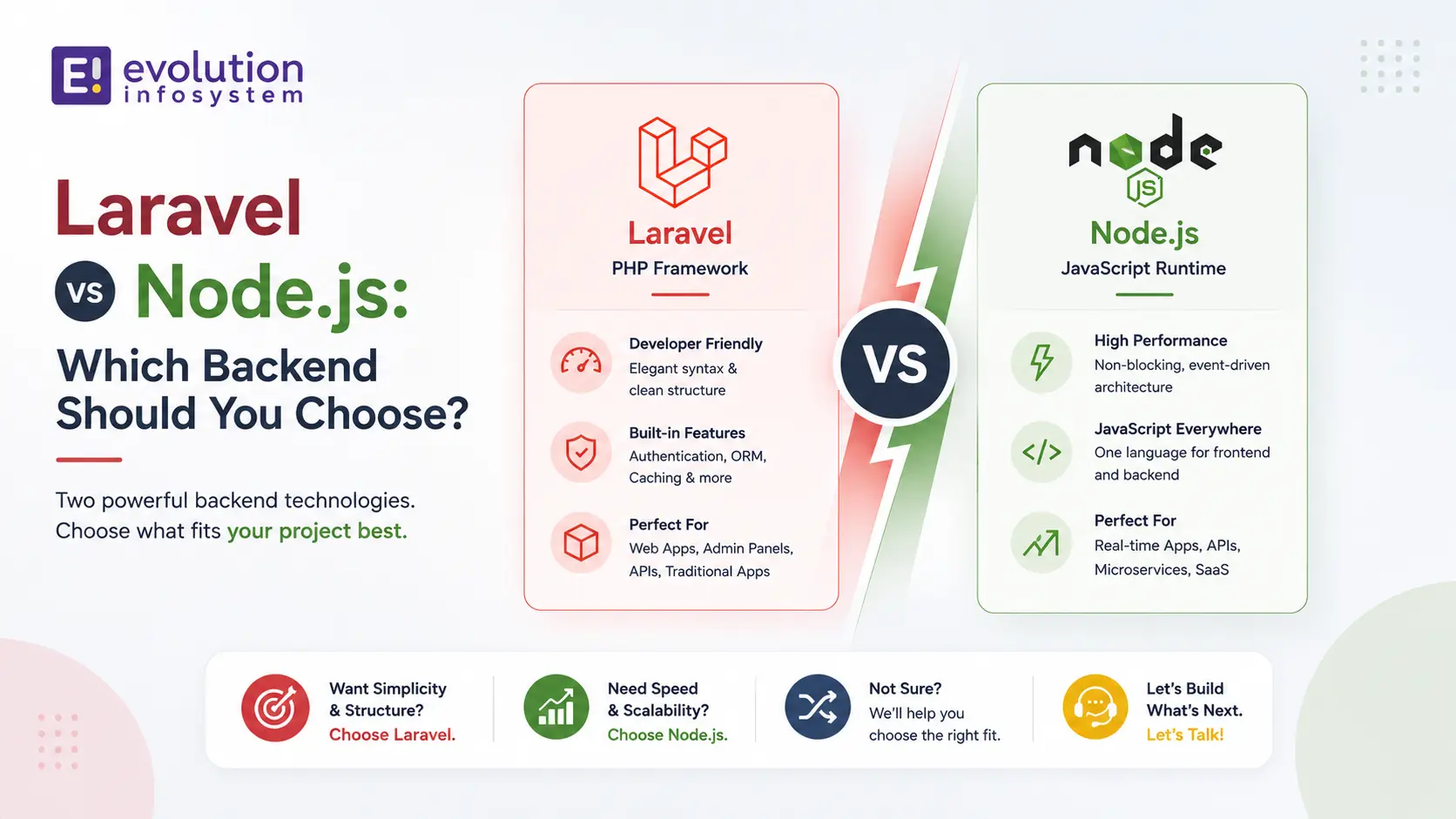
Every founder and CTO eventually hits the same wall: the frontend design is approved, the product roadmap is set, and now someone has to decide what runs the backend. This Laravel vs Node.js comparison exists because that one decision quietly shapes your hiring, your hosting bill, and your development speed for years.
Search results on this topic are full of surface-level lists that repeat the same “Laravel is a framework, Node.js is a runtime” line without ever telling you what to actually pick. This Laravel vs Node.js comparison is different – it walks through real project scenarios, current 2026 tooling, and a decision framework you can apply to your own product today.
We wrote this from an agency vantage point. Evolution has shipped production applications on both stacks, across CMS-heavy platforms, real-time dashboards, and API-first products. This Laravel vs Node.js comparison reflects what we have actually seen work, not just what benchmarks claim.
Who This Laravel vs Node.js Comparison Is For
This guide is written for three groups: founders scoping a new product, CTOs deciding whether to standardize their stack, and developers who want a clear-eyed view beyond framework loyalty. If you already know your use case, jump to the decision framework section later in this Laravel vs Node.js comparison.
If you are starting from zero, read straight through. Each section builds toward the same goal: helping you make a confident, defensible backend decision instead of picking based on whichever framework your last developer happened to know. By the end, you should be able to explain your choice in one paragraph, not one shrug.
Quick Answer: The Short Version of This Laravel vs Node.js Comparison
If you need a fast answer before reading the full breakdown, here it is. Choose Laravel if you are building a content-heavy, database-driven application – a CMS, an admin panel, an e-commerce backend, or a multi-role SaaS product – and want built-in structure with less setup.
Choose Node.js if your product depends on real-time features – live chat, notifications, streaming dashboards, WebSocket connections – or if your team is already JavaScript-first across the frontend and wants one language end to end.
That is the short version. The rest of this Laravel vs Node.js comparison explains exactly why, parameter by parameter, so you are not just taking our word for it – and so you can defend the decision confidently to a co-founder, investor, or engineering team who asks “why this stack and not the other one?”
What Is Laravel?
Laravel is a full-featured PHP framework built around the MVC (Model-View-Controller) pattern. It ships with routing, an ORM called Eloquent, authentication scaffolding, queue handling, and a templating engine called Blade, all included by default rather than assembled from separate packages.
That “batteries included” philosophy is the core of what makes Laravel distinct in any Laravel vs Node.js comparison – most of what a typical web application needs is already decided for you, following consistent, well-documented conventions.
What Is Node.js?
Node.js is not a framework – it is a JavaScript runtime built on Chrome’s V8 engine, which lets JavaScript run outside the browser on a server. On its own, Node.js gives you very little structure; most teams add a framework like Express, NestJS, or Fastify on top to shape it into a typical backend.
This distinction matters for any honest Laravel vs Node.js comparison: you are really comparing “a complete framework” against “a runtime plus whichever framework you choose to layer on it.” That flexibility is either Node.js’s biggest strength or its biggest source of decision fatigue, depending on your team.
Laravel vs Node.js Performance
Performance is the most debated part of any Laravel vs Node.js comparison, and also the most misunderstood. Node.js uses a non-blocking, event-driven I/O model, which makes it genuinely faster at handling many simultaneous lightweight requests – think chat messages, live notifications, or streaming data.
Laravel, running on modern PHP 8.x with JIT compilation, performs far better than PHP’s older reputation suggests, particularly for CPU-bound tasks and traditional request-response cycles. For the vast majority of business applications, though, neither framework is actually your bottleneck – your database queries, network latency, and server memory usually are.
A fair Laravel vs Node.js comparison should be honest about this: pick based on your application’s actual request pattern, not a synthetic benchmark that rarely reflects real production traffic.
What Benchmarks Actually Show
Synthetic benchmarks get cited constantly in Laravel vs Node.js comparison articles, so it is worth explaining what they actually measure. Most popular benchmarks test raw requests-per-second on a bare “hello world” endpoint, with no database call, no authentication check, and no business logic – nothing like a real application route.
In that narrow scenario, Node.js typically wins on raw throughput because of its non-blocking I/O model. But add a single database query, and the gap narrows dramatically, because both frameworks are now waiting on the same database round-trip. Add authentication, validation, and business logic, and the framework’s share of total response time shrinks further still.
The practical takeaway for this Laravel vs Node.js comparison: treat published benchmarks as a rough signal about I/O-heavy edge cases, not a prediction of how your specific application will perform in production.
Scalability
Both frameworks scale well when architected correctly, which makes scalability another area where a lazy Laravel vs Node.js comparison oversimplifies things. Laravel scales horizontally through load balancers, queue workers, and caching layers like Redis, and plenty of large-scale PHP applications run this way in production.
Node.js’s non-blocking model naturally handles a high volume of concurrent I/O-bound connections, which is why it is a common choice for microservices architectures and APIs serving many simultaneous clients. Neither framework hits a hard ceiling before your infrastructure or database design does.
Learning Curve and Developer Experience
Laravel’s convention-over-configuration approach means new developers can be productive quickly, since the framework makes most structural decisions for them. Clear documentation and consistent patterns across Laravel projects also shorten onboarding time for new team members.
Node.js has a lower barrier to entry for anyone who already knows JavaScript, but the lack of enforced structure means two Node.js codebases can look completely different depending on which framework and architectural choices the team made. This flexibility is powerful in experienced hands and confusing in inconsistent ones.
Ecosystem and Package Availability
Node.js runs on npm, the largest software package registry in the world, with millions of available packages. That scale is a double-edged sword – you will find a library for nearly anything, but quality varies wildly, and vetting dependencies becomes a real, ongoing responsibility.
Laravel’s Composer ecosystem is smaller but far more curated. First-party tools like Cashier for payments, Sanctum for API authentication, Horizon for queue monitoring, and Telescope for debugging are built by the same core team with consistent conventions, which reduces the guesswork this Laravel vs Node.js comparison sees teams struggle with when picking npm packages.
Security
Laravel includes strong security defaults out of the box: CSRF protection, prepared statements against SQL injection through Eloquent, hashed password storage, and built-in authentication scaffolding. Most common vulnerabilities are addressed before a developer writes a single line of custom code.
Node.js security depends heavily on which packages and middleware a team chooses to add, since the runtime itself does not enforce these protections. A well-configured Node.js application can be just as secure as Laravel, but it takes deliberate setup rather than arriving as a default.
Real-Time Capabilities
This is one of the clearest differentiators in any Laravel vs Node.js comparison. Node.js was practically built for real-time applications – WebSocket connections, live chat, collaborative editing tools, and streaming dashboards all play to its event-driven strengths naturally.
Laravel can handle real-time features through tools like Laravel Reverb or Pusher integration, and it works well for moderate real-time needs layered onto a primarily traditional application. But for a product where real-time interaction is the core feature, Node.js remains the more natural fit.
Database Support and ORM
Laravel’s Eloquent ORM offers an elegant, well-documented way to interact with relational databases like MySQL and PostgreSQL, with built-in support for migrations, relationships, and query building that keeps data logic organized and testable.
Node.js supports both relational databases through ORMs like Prisma or Sequelize and document databases like MongoDB through drivers like Mongoose, giving teams more flexibility to choose the database model that fits their data shape, at the cost of an extra decision to make upfront.
AI Integration: The 2026 Consideration
No current Laravel vs Node.js comparison is complete without addressing AI tooling, since it has become a real factor in backend decisions this year. Laravel’s AI SDK, now production-stable, gives Laravel a first-party, provider-agnostic way to integrate AI features without assembling third-party tooling from scratch.
Node.js teams building AI features typically assemble their own stack from libraries like LangChain.js or direct provider SDKs, which offers more control but adds more decisions. For teams new to AI integration, Laravel’s first-party approach reduces the decision surface. For teams already deep in the JavaScript AI ecosystem, Node.js remains just as capable.
Testing and Code Quality
Laravel ships with PHPUnit integration out of the box, along with helpers for testing HTTP requests, database interactions, and queued jobs without extensive setup. This built-in testing scaffolding is another area where Laravel reduces early decision-making compared to assembling a testing stack from scratch.
Node.js testing typically relies on separate tools like Jest, Mocha, or Vitest, which are mature and widely documented but require the team to choose and configure them. TypeScript adoption has also meaningfully improved Node.js code quality by catching type errors before runtime, addressing one of plain JavaScript’s longest-standing weaknesses in any serious Laravel vs Node.js comparison.
Deployment and DevOps Considerations
Laravel applications typically deploy to traditional PHP-friendly hosting, managed platforms like Laravel Forge or Vapor, or standard Linux servers running Nginx and PHP-FPM. The deployment story is mature and well-documented, with predictable server requirements.
Node.js applications deploy naturally to serverless platforms, containerized environments, and edge runtimes, since the JavaScript ecosystem has invested heavily in cloud-native tooling. Teams already using Docker and Kubernetes for their frontend infrastructure often find Node.js backend deployment fits the same pipeline with less friction.
Neither deployment path is objectively harder – this part of the Laravel vs Node.js comparison usually comes down to what your DevOps team already knows and what your hosting budget supports.
Who Actually Uses Laravel and Node.js in Production
Real-world adoption is a useful, if imperfect, data point in any Laravel vs Node.js comparison. Laravel powers a large share of small and mid-sized business websites, SaaS admin panels, and CMS-driven platforms worldwide, prized for how quickly teams can ship maintainable features.
Node.js is used at significant scale by companies like Netflix, LinkedIn, PayPal, and Uber, largely for its ability to handle high-concurrency, real-time, and microservices workloads. Neither list should be read as “which is objectively better” – it reflects which companies had real-time or high-concurrency problems that Node.js’s architecture happened to solve well.
Total Cost of Ownership Beyond Initial Development
A narrow Laravel vs Node.js comparison stops at development cost. A complete one accounts for hosting, ongoing maintenance, and the cost of hiring replacements when developers move on – all of which compound over a product’s lifetime.
- Hosting: Laravel often runs comfortably on modest shared or VPS hosting for small-to-mid traffic; Node.js scales cost-efficiently on serverless platforms that charge per execution
- Maintenance: Laravel’s conventions make it easier for a new developer to pick up an existing codebase quickly; Node.js maintainability depends heavily on how disciplined the original team was
- Upgrades: Laravel’s structured release cycle makes version upgrades relatively predictable; Node.js dependency updates across many npm packages can require more ongoing attention
- Talent replacement: factor in your local market’s availability of each skill set, not just global talent pool size
Weighing total cost of ownership, rather than only the first invoice, is one of the more overlooked steps in a thorough Laravel vs Node.js comparison – and it is often where the real difference in five-year cost shows up.
Cost and Development Timeline
Laravel often gets products to a working, maintainable state faster for CRUD-heavy applications, simply because so much scaffolding – authentication, admin structure, form validation – comes built in. This tends to compress early development timelines and, by extension, early-stage cost.
Node.js development cost depends heavily on which framework layer you choose and how much custom architecture your team builds. A well-scoped Node.js project with NestJS can move nearly as fast as Laravel; an unstructured Express project without conventions can slow down as the codebase grows.
Any Laravel vs Node.js comparison focused purely on hourly rates misses the bigger cost driver: how much rework a mismatched stack creates six months into a project, once real requirements surface.
Hiring and Talent Pool
Node.js has a larger raw talent pool simply because JavaScript is the most widely known language among web developers, and any frontend developer can transition into backend work with a shorter ramp-up period.
Laravel developers are a smaller but often more specialized pool, and PHP remains one of the most widely deployed server-side languages globally, powering a large share of the web. Hiring difficulty in this Laravel vs Node.js comparison usually depends more on your local market than on either technology’s overall popularity.
When Laravel Is the Stronger Choice
Based on the parameters above, this Laravel vs Node.js comparison points toward Laravel when the following apply to your project.
- Content management systems, admin panels, or data-driven websites
- Multi-role authentication and complex permission systems
- E-commerce backends, booking systems, or subscription platforms
- Projects needing PDF generation, scheduled tasks, and email workflows out of the box
- Teams that want convention over configuration and faster initial setup
- Businesses wanting a first-party AI integration path without assembling one manually
When Node.js Is the Stronger Choice
On the other side of this Laravel vs Node.js comparison, Node.js pulls ahead clearly in these situations.
- Real-time applications: chat, live notifications, collaborative tools, streaming dashboards
- High-concurrency APIs serving many lightweight simultaneous requests
- Microservices architectures where services need to communicate quickly
- Teams already working in JavaScript/TypeScript across the frontend, wanting one shared language
- Products built on React, Next.js, Vue, or Angular where full-stack JavaScript reduces context switching
Can You Use Both? The Hybrid Approach
Many production systems do not force a single winner out of this Laravel vs Node.js comparison – they use both, deliberately. Laravel handles the core application logic: the admin dashboard, data models, business processes, and the primary API. A separate Node.js service handles the real-time layer: live chat, notifications, or WebSocket connections.
This is not over-engineering when scoped correctly; it is using each tool where it is strongest. For most startups and SMEs building their first substantial application, though, starting with a single stack and adding a second service later, once a genuine real-time need emerges, keeps early development simpler.
Common Mistakes When Choosing Between Laravel and Node.js
Mistake 1: Choosing Based on Framework Popularity Alone
Trend-chasing leads teams to pick Node.js because “everyone uses JavaScript” or Laravel because “it is the standard PHP choice,” without weighing the actual technical requirements this Laravel vs Node.js comparison covers above.
Mistake 2: Ignoring the Team’s Existing Skill Set
Choosing the objectively “better” framework for a use case, while ignoring that your team has zero experience with it, often costs more in ramp-up time than the framework choice saves in theoretical performance.
Mistake 3: Benchmarking Synthetic Load Instead of Real Usage
Raw requests-per-second benchmarks rarely reflect how your actual users will hit the application. Model your real traffic pattern before letting a generic benchmark decide your stack.
Mistake 4: Underestimating Long-Term Maintenance
A stack that ships fast but lacks structure can become expensive to maintain as the team and codebase grow. Factor in maintainability, not just initial build speed, when running your own Laravel vs Node.js comparison.
Migrating Between Laravel and Node.js
Sometimes the right answer to this Laravel vs Node.js comparison is “neither, going forward” – a team outgrows their original stack and needs to migrate. This is a significant undertaking, not a weekend project, and it deserves careful planning. Common triggers include a growing real-time requirement that the current stack cannot handle gracefully, a team’s skill set shifting entirely toward one language, or a legacy codebase that has become too costly to maintain safely.
- Audit existing functionality and prioritize what must be replicated exactly versus what can be rebuilt better
- Plan a phased migration by module or service rather than a single full rewrite
- Keep both systems running in parallel during transition where possible, to avoid downtime
- Budget extra time for data migration and integration testing, which is usually underestimated
If migration is on your roadmap, it is worth having an experienced development partner assess feasibility before committing, since a rushed migration often costs more than the original build.
Community Support and Long-Term Viability
Longevity matters when you are betting a product on a backend stack. Laravel has maintained a consistent release cadence for over a decade, with a large, active community, extensive documentation, and a clear upgrade path between major versions – all of which reduce the risk of picking an abandoned framework.
Node.js itself is backed by the OpenJS Foundation and used across nearly every major tech company, which makes the runtime’s long-term viability effectively guaranteed. The bigger long-term risk on the Node.js side is framework churn within the ecosystem – Express, NestJS, and Fastify each have different release philosophies, so pick the framework layer as deliberately as you pick Node.js itself.
Either side of this Laravel vs Node.js comparison represents a safe long-term bet at the runtime and framework level. The real long-term risk in most projects is inconsistent internal conventions, not the technology choice itself.
Pros and Cons Summary
Laravel: Pros
- Built-in structure speeds up development for standard web applications
- Strong security defaults reduce common vulnerabilities out of the box
- Curated, first-party ecosystem (Cashier, Sanctum, Horizon, Telescope)
- Production-stable first-party AI SDK as of Laravel 13
- Excellent documentation and consistent conventions across projects
Laravel: Cons
- Less naturally suited to real-time, high-concurrency workloads
- Requires PHP-specific hosting knowledge for optimal performance tuning
- Smaller overall talent pool than JavaScript in some markets
Node.js: Pros
- Excellent for real-time features and high-concurrency I/O workloads
- Shared language with frontend JavaScript/TypeScript reduces context switching
- Massive npm ecosystem with a package for nearly any use case
- Strong fit for serverless and edge deployment models
Node.js: Cons
- No enforced structure, so code quality depends heavily on team discipline
- Package quality varies, requiring ongoing dependency vetting
- Security features must be deliberately added rather than arriving by default
Laid out side by side like this, the Laravel vs Node.js comparison becomes less about which framework is “better” and more about which set of trade-offs your team is better equipped to manage.
A Decision Framework You Can Actually Use
To make this Laravel vs Node.js comparison actionable, run your project through these four questions in order.
- Does your product depend on real-time features as a core function, not a nice-to-have? If yes, lean Node.js.
- Is your application primarily data-driven with multiple user roles and admin workflows? If yes, lean Laravel.
- Is your team already JavaScript-first across the frontend? If yes, Node.js reduces context switching.
- Do you need to ship a working MVP with minimal setup decisions? If yes, Laravel’s conventions get you there faster.
Most projects will answer “yes” to more than one of these, which is exactly why this Laravel vs Node.js comparison avoids declaring a single universal winner – the right answer depends on which of your requirements matters most.
A Quick Example: Choosing a Backend for a Booking Platform
Picture a Rajkot-based startup building a service-booking platform with admin scheduling, customer accounts, and payment processing. Following this Laravel vs Node.js comparison’s framework, the multi-role admin panel and payment workflows point toward Laravel as the primary backend.
The team scopes their MVP with Laravel: Eloquent models for bookings and providers, Sanctum for customer and admin authentication, and Cashier for subscription billing on the provider side. Because most of this scaffolding ships with Laravel by default, the team reaches a working MVP in a fraction of the time a from-scratch Node.js build would take for the same feature set.
If the platform later adds live booking-slot updates or in-app chat between customers and providers, a lightweight Node.js service can be layered in for just that real-time piece – exactly the hybrid pattern described earlier in this Laravel vs Node.js comparison. The core application stays on Laravel; only the feature that genuinely needs Node.js’s strengths gets built on it.
Frequently Asked Questions (FAQs)
Is Laravel or Node.js better for a startup MVP?
For most first-time MVPs with standard CRUD functionality, Laravel typically gets you to a working product faster because of its built-in scaffolding. If your MVP’s core feature is real-time interaction, Node.js is the better starting point instead.
Is Node.js faster than Laravel?
Node.js is generally faster for high-concurrency, I/O-bound workloads, while modern Laravel on PHP 8.x performs strongly for CPU-bound and traditional request-response tasks. For most applications, database performance matters more than either framework’s raw speed.
Can Laravel handle real-time applications?
Yes, through tools like Laravel Reverb or third-party services like Pusher, Laravel can support real-time features. It is not as naturally suited to it as Node.js, but it works well for moderate real-time needs alongside a primarily traditional application.
Which is cheaper to develop: Laravel or Node.js?
Neither is inherently cheaper – cost depends more on project complexity and how well the stack fits your requirements than on the technology itself. A mismatched stack chosen for the wrong reasons usually costs more in rework than either framework saves upfront.
Do I need separate developers for Laravel and Node.js?
Yes, generally. Laravel requires PHP expertise while Node.js requires JavaScript/TypeScript expertise, and while some developers know both, most specialize in one. Factor hiring availability into your decision alongside the technical comparison.
Is Laravel or Node.js better for SEO?
Neither backend framework directly determines SEO outcomes, since SEO depends more on how the frontend renders content, page speed, and site structure. Both can power SEO-friendly applications when paired with proper frontend rendering strategy.
Can I switch from Laravel to Node.js later, or vice versa?
Yes, though it is a significant project, not a quick swap. A phased, module-by-module migration with parallel systems running during transition is the safest approach, and it is worth having an experienced team assess feasibility before committing to a full rewrite.
Which stack is better for a mobile app backend?
Both work well as an API backend for mobile apps. Laravel Sanctum handles token-based mobile authentication cleanly, while Node.js’s lightweight JSON handling and real-time capability suit mobile apps needing live updates, such as chat or location tracking features.
How long does a typical Laravel or Node.js project take to build?
A standard MVP with authentication, a database-driven core, and basic admin functionality typically takes several weeks to a few months on either stack, depending on scope. Laravel projects often reach a working state slightly faster due to built-in scaffolding, while Node.js timelines vary more based on which framework layer and architecture the team chooses.
Key Takeaways
- Laravel is a full framework with built-in structure; Node.js is a runtime that needs a framework layered on top
- Choose Laravel for data-driven, multi-role applications that need to ship fast with less setup
- Choose Node.js for real-time features, high-concurrency APIs, and JavaScript-first teams
- Neither framework is a universal performance winner – your database and architecture usually matter more
- Many production systems successfully combine both, using each where it is strongest
- Factor in hiring availability and long-term maintenance, not just initial build speed
Every point on this list came up repeatedly while researching this Laravel vs Node.js comparison, and each one reflects a decision that real teams get wrong when they skip the analysis and default to whichever framework is trendiest.
Frontend Pairing: Which Frontend Fits Each Backend Best
Your frontend choice often influences this Laravel vs Node.js comparison more than teams expect. Laravel pairs naturally with Blade templates for traditional server-rendered pages, or with Inertia.js to build a Vue or React frontend without maintaining a separate API layer.
Node.js pairs most naturally with React, Next.js, Vue, or Angular, since the entire stack runs on JavaScript/TypeScript end to end. Next.js in particular blurs the line further, handling both frontend rendering and lightweight backend API routes within a single Node.js-based framework.
If your team already has a strong frontend framework preference, it is worth letting that preference inform this Laravel vs Node.js comparison rather than treating the backend decision in isolation – a mismatched pairing adds friction that a well-matched one avoids entirely.
Why the Development Partner Matters as Much as the Framework
A recurring theme throughout this Laravel vs Node.js comparison is that outcomes depend less on the framework itself and more on how disciplined the team building on it is. A skilled Laravel team and a skilled Node.js team will both ship maintainable, secure applications; an unstructured team can produce a fragile codebase on either stack.
When evaluating a development partner for either path, ask about their testing practices, code review process, and how they handle framework upgrades over time – not just which stack they prefer. A partner comfortable working across both technologies, rather than pushing whichever one they know best, is more likely to recommend the right fit for your specific project instead of their personal preference.
This is also where a genuinely neutral Laravel vs Node.js comparison earns its usefulness: it should leave you equipped to ask sharper questions of any agency you talk to, regardless of which stack they ultimately propose.
Final Thoughts
There is no universal winner in the Laravel vs Node.js comparison – only the right fit for your specific product, team, and timeline. Data-driven applications with complex admin needs tend to favor Laravel; real-time, JavaScript-first products tend to favor Node.js. Most projects have a clear answer once you honestly weigh your actual requirements against the parameters covered here.
If you are still unsure after running through this Laravel vs Node.js comparison, that uncertainty itself is useful information – it usually means your project could genuinely work on either stack, and the deciding factor should be your team’s existing skills and hiring plans rather than a theoretical technical edge.
Evolution’s custom web application development and MEAN stack development teams build production applications on both Laravel and Node.js, and we are happy to review your specific requirements and recommend a stack rather than defaulting to whichever technology we happen to prefer.
If your project also touches PHP-based requirements, our LAMP stack development team can help you evaluate that path too, so your final decision is based on your product, not on this Laravel vs Node.js comparison alone.