REST API vs GraphQL: Which Should You Use?
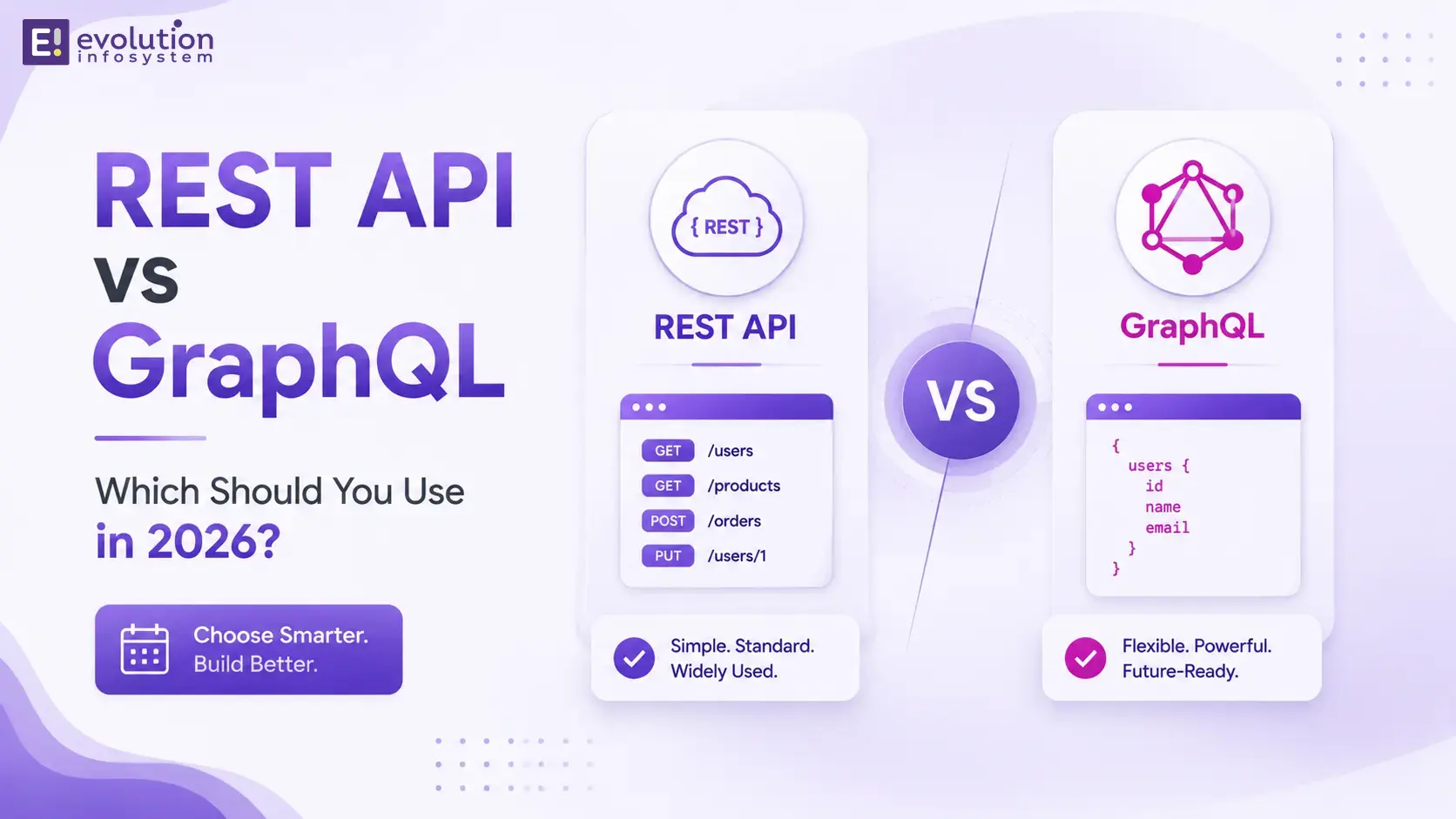
Every backend team eventually has this argument: should the new product talk to clients through a REST API, or should it use GraphQL instead? This REST API vs GraphQL comparison exists because the decision affects your caching strategy, your mobile performance, and how many endpoints your team maintains for years afterward.
Most articles on this topic either declare GraphQL the modern winner or defend REST out of habit. This REST API vs GraphQL comparison avoids both traps. It walks through the real trade-offs — caching, over-fetching, tooling, and team structure — using 2026 production data instead of theory.
We wrote this from an agency perspective. Evolution has built and maintained both REST and GraphQL APIs for client products, and this REST API vs GraphQL comparison reflects what actually breaks or scales well in production, not just what a specification document promises.
Who This REST API vs GraphQL Comparison Is For
This guide is for founders scoping a new product’s API layer, backend developers standardizing a team’s approach, and architects deciding whether an existing REST API needs a GraphQL layer added on top. If you already know your use case, skip ahead to the decision framework later in this REST API vs GraphQL comparison.
If you are new to both technologies, read straight through — each section builds on the last, ending in a framework you can apply directly to your own project rather than a generic “it depends.” By the end, you should be able to defend your choice in one clear paragraph to a co-founder or stakeholder, not just shrug and say “GraphQL felt more modern.”
Quick Answer: The Short Version
If you need the short version of this REST API vs GraphQL comparison before the full breakdown: choose REST for public APIs, simple resource-based services, and anything that benefits from standard HTTP caching. It remains the default for the majority of production APIs in 2026 for good reason.
Choose GraphQL when you have multiple client types — web, iOS, Android, partner dashboards — each needing different shapes of the same data, or when your screens require pulling from many related resources in a single round trip. Many mature products end up using both, and that hybrid pattern is more common than either side of this debate usually admits. Keep that pattern in mind as you read the rest of this REST API vs GraphQL comparison — it will come up again.
What Is a REST API?
REST (Representational State Transfer) is an architectural style built around resources and standard HTTP methods: GET, POST, PUT, PATCH, and DELETE. Each resource, like a user or an order, typically has its own endpoint, and the server decides exactly what shape of data each endpoint returns.
That predictability is central to any REST API vs GraphQL comparison. Because REST maps naturally onto HTTP, it inherits HTTP’s caching, status codes, and tooling for free — a CDN can cache a GET request without any custom configuration.
What Is GraphQL?
GraphQL is a query language and runtime, not a transport protocol. Instead of many endpoints, a GraphQL API typically exposes a single endpoint and a schema describing every available type and field. Clients write a query describing exactly the data they want, and the server returns precisely that shape, nothing more and nothing less.
This single-endpoint, client-defined-shape model is the core of what makes GraphQL different in any REST API vs GraphQL comparison. It solves over-fetching and under-fetching directly, at the cost of giving up some of REST’s built-in simplicity.
REST API vs GraphQL: Data Fetching
This is where the REST API vs GraphQL comparison usually starts, because it is the most visible difference. With REST, assembling one screen often means calling several endpoints — /user, then /user/orders, then /orders/{id}/items — and each response typically returns more fields than the screen actually needs.
With GraphQL, the client sends one query describing exactly the nested data it wants across multiple related resources, and gets back one response with precisely that shape. This removes over-fetching and collapses several round trips into one, which matters most on slow mobile connections.
The trade-off this REST API vs GraphQL comparison must be honest about: REST puts response shape decisions with the server, keeping things simple and predictable, while GraphQL hands that decision to the client, trading simplicity for flexibility.
Caching: REST’s Biggest Structural Advantage
Caching is arguably the single biggest differentiator in this REST API vs GraphQL comparison, and it does not get enough attention. A REST GET endpoint can be cached at the CDN, browser, or proxy level with nothing more than a Cache-Control header — subsequent identical requests never even reach your server.
GraphQL typically sends all queries as POST requests to a single endpoint, which bypasses standard HTTP caching entirely by default. Persisted queries and GET-based query execution can partially restore caching, but both require deliberate engineering effort that REST gets for free.
For any product where caching drives your infrastructure cost or your global latency, this REST API vs GraphQL comparison tips meaningfully toward REST unless you are prepared to invest in GraphQL-specific caching tooling.
Performance: What the Numbers Actually Show
GraphQL can reduce the number of API calls substantially in complex data scenarios by collapsing multiple REST round trips into one query. That is a genuine, measurable win for screens pulling from many related resources, especially on constrained mobile networks.
But performance in this REST API vs GraphQL comparison is not one-directional. Poorly structured GraphQL queries can trigger N+1 database query problems, where a single query fans out into dozens of underlying database calls unless the backend uses batching tools like DataLoader. REST endpoints, by contrast, tend to have simpler, more predictable performance characteristics out of the box.
The honest takeaway: raw benchmark numbers favor whichever side is being measured in its best-case scenario. Model your actual query patterns before letting a generic benchmark decide your REST API vs GraphQL comparison.
Tooling and Developer Experience
REST tooling is mature and universal — every HTTP client, monitoring tool, and API gateway understands status codes, rate limiting per route, and WAF rules natively. A resource-based JSON API is something virtually every developer you hire will already understand.
GraphQL’s schema is a typed, introspectable contract, which gives it excellent code generation, mocking, and documentation tooling. The tooling gap that existed between REST and GraphQL a few years ago has largely closed — OpenAPI 3.1 and GraphQL SDL now sit at rough parity for client generation and docs, a real shift worth noting in any current REST API vs GraphQL comparison.
One operational catch: a GraphQL API typically returns HTTP 200 for most errors, packing the actual error inside the response body. Every monitoring tool your team uses has to be taught this, which is not the case with REST’s native use of HTTP status codes.
Client Diversity: Where GraphQL Earns Its Complexity
This is the scenario every fair REST API vs GraphQL comparison should highlight as GraphQL’s clearest win. When a product has a web app, iOS app, Android app, and a partner dashboard, each needing a different slice of the same underlying data, REST tends to sprout endpoint variations like /dashboard/mobile and /dashboard/desktop.
That pattern becomes a maintenance burden fast — every new client requirement means a new endpoint or a growing pile of query parameters. GraphQL lets each client fetch exactly its own shape from the same schema, without a dedicated backend-for-frontend layer per platform.
If your product genuinely serves several different client types with meaningfully different data needs, this part of the REST API vs GraphQL comparison should carry real weight in your decision.
Security Considerations
REST security benefits from decades of established patterns: per-route rate limiting, standard authentication middleware, and a WAF ecosystem built around HTTP methods and paths. Most security tooling assumes a REST-shaped API by default.
GraphQL introduces its own security considerations. Because a single endpoint accepts arbitrarily nested queries, teams need query complexity analysis and depth limiting to prevent a malicious or accidental query from requesting an unreasonably expensive response. This is infrastructure most REST APIs never need to think about.
Neither side of this REST API vs GraphQL comparison is inherently less secure — but GraphQL requires deliberately adding protections that REST’s architecture provides more naturally by default.
Versioning: How Each Approach Evolves Over Time
REST APIs typically version through the URL path or headers — /v1/users versus /v2/users — giving teams a clear, explicit way to introduce breaking changes without disrupting existing clients. This approach is well understood and easy to communicate to external API consumers.
GraphQL takes a different philosophy in this REST API vs GraphQL comparison: rather than versioning the whole API, teams add new fields and deprecate old ones within the same schema, using the @deprecated directive to signal upcoming removals. Clients only request the fields they use, so most schema evolution happens without breaking existing queries.
Neither approach is objectively superior, but GraphQL’s continuous evolution model requires more schema governance discipline, while REST’s versioning model requires more coordination around deprecating old versions entirely.
Real-Time Data: Subscriptions vs Polling and WebSockets
GraphQL includes subscriptions as a first-class part of its specification, giving clients a standardized way to receive live updates over a persistent connection when data changes. This is a meaningful convenience this REST API vs GraphQL comparison should note for products with live, event-driven features.
REST has no native equivalent — real-time updates typically require polling an endpoint repeatedly, or layering a separate WebSocket connection on top of the REST API entirely. Both approaches work in production, but REST’s real-time story always involves adding something extra rather than using a built-in feature.
If your product’s core value depends heavily on live updates, this is a point in GraphQL’s favor within this REST API vs GraphQL comparison, though a well-implemented WebSocket layer over REST remains a perfectly viable alternative.
Error Handling
REST uses HTTP status codes as its primary error-signaling mechanism: 404 for not found, 401 for unauthorized, 500 for server errors, and so on. This is immediately understandable to any monitoring tool, load balancer, or developer without additional documentation.
GraphQL typically returns a 200 status code even when part of a query fails, embedding error details inside the response body’s errors array instead. This gives GraphQL more granular, field-level error reporting — useful when only part of a complex query fails — but it means every tool in your monitoring stack needs to be taught to look inside the response body rather than trusting the status code alone.
Cost to Build and Maintain
Initial development cost in this REST API vs GraphQL comparison often favors REST for simple applications, since the tooling, hosting, and hiring pool are all more mature and require less specialized setup. A basic CRUD REST API can be scaffolded quickly with any major backend framework.
GraphQL’s upfront cost tends to be higher because of the schema design work, resolver implementation, and the batching or caching infrastructure needed to avoid N+1 problems. That cost is often recovered later, though, if it eliminates the need to build and maintain multiple REST endpoint variations for different client types.
Long-term maintenance cost depends heavily on team discipline either way. A REST API with inconsistent endpoint design can become just as costly to maintain as a poorly governed GraphQL schema — the technology choice matters less than the ongoing discipline applied to it.
Hiring and Team Considerations
REST’s talent pool is effectively universal — nearly every backend developer has built a REST API, which makes hiring and onboarding faster regardless of your team’s size or location. This is a meaningful, often underweighted factor in any REST API vs GraphQL comparison.
GraphQL developers are a smaller, more specialized pool, though the gap has narrowed significantly as GraphQL adoption has grown across the industry. Teams adopting GraphQL should budget for a learning curve even among experienced backend developers who have only worked with REST previously.
File Uploads, Webhooks, and Public Consumption
REST handles file uploads naturally through multipart/form-data, a well-understood standard supported by every HTTP client and server framework without extra tooling. Webhooks — where your server pushes data to another system — are also a natural fit for REST’s request-response model.
GraphQL was not designed with file uploads or webhooks as first-class citizens, and both require workarounds or separate REST endpoints alongside the GraphQL schema. For APIs meant for public, third-party consumption, this REST API vs GraphQL comparison leans toward REST, since it is more natural for parties you do not control to integrate with.
Testing Strategies for Each Approach
REST APIs are straightforward to test with tools like Postman or automated HTTP test suites, since each endpoint has a predictable, isolated request and response shape. Contract testing between services is also well-established in the REST ecosystem.
GraphQL testing needs to account for the fact that a single endpoint can serve infinitely many different queries, so testing tends to focus on resolver-level unit tests and schema validation rather than endpoint-by-endpoint coverage. Tools like GraphQL Inspector help catch breaking schema changes before they reach production, which is a distinctly GraphQL-shaped concern within this REST API vs GraphQL comparison.
Documentation: Generated vs Written
REST documentation traditionally relies on the OpenAPI (Swagger) specification, which can generate interactive docs, but keeping that specification accurate requires discipline, since nothing forces the code and the documentation to stay in sync automatically.
GraphQL’s schema is inherently self-documenting — every type, field, and argument is introspectable directly from the API itself, and tools like GraphiQL or Apollo Studio generate interactive documentation automatically from the live schema. This built-in accuracy is a genuine advantage worth weighing in any REST API vs GraphQL comparison focused on long-term API consumer experience.
Real-World Adoption in 2026
REST still powers the large majority of public APIs in 2026, remaining the default for server-to-server integration and most product backends. GraphQL has moved firmly into production at the enterprise tier, but usually as an aggregation layer over REST or gRPC services rather than a full replacement.
The dominant pattern in this REST API vs GraphQL comparison is Backend-for-Frontend: internal service-to-service traffic stays REST or gRPC, while external clients consume a single GraphQL graph. Companies including Netflix, GitHub, Shopify, and Airbnb run some version of this hybrid model in production today.
GraphQL Federation has also matured significantly, letting distributed teams own separate subgraphs that compose into one unified schema — an approach adopted at scale by large organizations managing many independent backend teams. This solves a coordination problem that a purely REST-based microservices architecture often struggles with: without federation, each client typically has to know which of dozens of REST services to call for each piece of data, whereas a federated GraphQL graph presents all of it through one coherent schema.
The Under-Discussed GraphQL Trade-Off: Query Complexity as a Support Burden
Most REST API vs GraphQL comparison articles cover over-fetching and under-fetching but skip a quieter cost: GraphQL shifts response-shape decisions to whoever is writing the client query, which means backend teams now field questions from frontend developers about which combination of fields produces the fastest query.
With REST, that conversation rarely happens, because the server already decided the response shape. This is not a reason to avoid GraphQL, but it is a real, ongoing collaboration cost that a purely technical REST API vs GraphQL comparison can undersell. Teams that pair GraphQL adoption with clear internal guidelines on query patterns tend to avoid this friction almost entirely.
Environmental and Infrastructure Cost Considerations
A less-discussed angle in most REST API vs GraphQL comparison content is infrastructure cost at scale. REST’s native CDN caching means a large share of repeat requests never touch application servers at all, which can meaningfully reduce compute and database load for read-heavy applications.
GraphQL’s default bypass of HTTP caching means more requests reach your application layer unless you invest in persisted queries or a dedicated GraphQL caching solution like Apollo’s response cache. For high-traffic, read-heavy public applications, this REST API vs GraphQL comparison factor can translate directly into hosting cost, not just theoretical performance.
When REST Is the Stronger Choice
Based on everything above, this REST API vs GraphQL comparison points toward REST when these conditions apply to your project.
- Public APIs consumed by third parties you do not control
- Simple, resource-oriented services with straightforward CRUD operations
- Applications that depend heavily on CDN or HTTP caching for performance and cost
- Small teams that want tooling and hiring to be as simple as possible
- APIs requiring native file upload or webhook support without extra workarounds
When GraphQL Is the Stronger Choice
On the other side of this REST API vs GraphQL comparison, GraphQL pulls ahead clearly in these situations.
- Multiple client types (web, iOS, Android, partner dashboards) needing different data shapes
- Complex, deeply nested data screens that would otherwise require many REST round trips
- Mobile-heavy products where reducing round trips meaningfully improves perceived performance
- Large organizations needing federation across many independently owned backend services
- Teams willing to invest in query complexity limiting and custom caching infrastructure
The Hybrid Approach: Using Both Together
Most mature engineering organizations do not treat this REST API vs GraphQL comparison as a single, permanent choice. The most common production pattern keeps internal, service-to-service communication on REST or gRPC, while a GraphQL layer sits in front, aggregating data for external clients.
This is not complexity for its own sake — it uses each approach where it is strongest. For most startups and SMEs, though, starting with a single REST API and adding a GraphQL aggregation layer later, once genuine client diversity emerges, keeps early development simpler and avoids premature infrastructure investment. Resist the urge to build for a scale you have not reached yet; the hybrid pattern works best when it is added in response to a real, observed need rather than anticipated ahead of time.
Common Mistakes When Choosing Between REST and GraphQL
Mistake 1: Adopting GraphQL Because It Feels Modern
Choosing GraphQL purely because it is newer, without a genuine client-diversity or nested-data problem to solve, often adds infrastructure complexity — query depth limiting, custom caching — that a simple REST API would never have needed.
Mistake 2: Ignoring N+1 Query Risk in GraphQL
Teams that launch a GraphQL API without batching tools like DataLoader often discover N+1 database query problems only after real traffic arrives, when a single nested query fans out into dozens of database calls.
Mistake 3: Underestimating REST’s Caching Advantage
Teams sometimes migrate a cache-friendly REST API to GraphQL without accounting for the caching infrastructure they now have to rebuild themselves, quietly increasing both cost and latency.
Mistake 4: Treating This as an All-or-Nothing Decision
Many teams assume they must fully commit to one side of this REST API vs GraphQL comparison, when the hybrid Backend-for-Frontend pattern described above is often the more practical, lower-risk path.
Migrating From REST to GraphQL (or Back)
Sometimes a team concludes their current approach no longer fits and needs to migrate. This is a genuine engineering project, not a quick swap, and deserves the same planning as any other REST API vs GraphQL comparison decision. Common triggers include a growing number of client-specific REST endpoint variations becoming unmanageable, or a GraphQL API whose caching costs have grown large enough to justify moving high-traffic public routes back to cache-friendly REST.
- Start by adding a GraphQL layer in front of existing REST endpoints rather than rewriting the backend from scratch
- Migrate client-by-client or screen-by-screen instead of attempting a single full cutover
- Keep REST endpoints available for third-party integrations even after internal clients move to GraphQL
- Budget real time for query complexity analysis and caching infrastructure before going live
A Decision Framework You Can Actually Use
To make this REST API vs GraphQL comparison actionable, run your project through these four questions in order.
- Do you have multiple, meaningfully different client types consuming the same data? If yes, lean GraphQL.
- Does your API need to be consumed by third parties you do not control? If yes, lean REST.
- Does CDN or HTTP caching drive a meaningful share of your performance or cost? If yes, lean REST.
- Are your screens pulling from many deeply nested, related resources in a single view? If yes, lean GraphQL.
Most real products will answer “yes” to at least one question on each side, which is exactly why this REST API vs GraphQL comparison keeps returning to the hybrid pattern rather than declaring one universal winner.
A Quick Example: Choosing an API Layer for a Multi-Platform App
Picture a Rajkot-based startup building a service marketplace with a web app, an Android app, and a partner-facing dashboard for vendors. Following this REST API vs GraphQL comparison’s framework, the client diversity and differing data needs across three platforms point toward introducing GraphQL as an aggregation layer.
The team keeps their existing REST endpoints for internal services and third-party payment webhooks, and adds a GraphQL layer specifically for the three client applications. Each client fetches exactly the fields it needs, while the underlying services stay REST-based and cache-friendly — the hybrid pattern this REST API vs GraphQL comparison recommends for most growing products.
Six months in, the vendor dashboard needs live order notifications. Rather than building a separate polling system, the team adds a GraphQL subscription for that one feature, while everything else stays untouched. This incremental approach — solving one real problem at a time rather than redesigning the whole API layer upfront — is the pattern most successful REST API vs GraphQL comparison case studies actually follow in practice.
Frequently Asked Questions
Is GraphQL faster than a REST API?
GraphQL can reduce the number of round trips for complex, nested data, which often feels faster on mobile networks. But poorly optimized GraphQL queries can be slower than REST due to N+1 database query problems, so the honest answer depends on how well the API is built.
Can GraphQL replace REST entirely?
In most production systems, no. GraphQL commonly sits as an aggregation layer in front of REST or gRPC services rather than replacing them outright, particularly for internal service-to-service communication and public, third-party-facing endpoints.
Does GraphQL support caching like REST does?
Not natively. REST’s GET requests cache at the CDN and browser level for free, while GraphQL’s POST-based query model bypasses that by default. Persisted queries and GET-based execution can partially restore caching, but they require deliberate setup.
Is REST or GraphQL easier for beginners to learn?
REST is generally easier to learn first, since it maps directly onto familiar HTTP concepts most developers already know. GraphQL has a steeper initial learning curve around schemas, resolvers, and query structure, though its tooling has improved significantly.
Do I need a different backend framework for GraphQL versus REST?
No. Most backend frameworks, including Laravel and Node.js-based frameworks like Express or NestJS, support both REST and GraphQL through available libraries, so your framework choice does not lock you into one API style.
Which is better for a startup MVP: REST or GraphQL?
For most first-time MVPs with a single web client, REST is the simpler, faster starting point. GraphQL earns its complexity once you have multiple client types or genuinely nested data requirements, which most MVPs have not yet reached.
Can I use REST and GraphQL in the same project?
Yes, and it is increasingly the norm rather than the exception. Many production systems keep REST for internal services, webhooks, and public integrations, while adding a GraphQL layer specifically for client applications that benefit from flexible, nested queries.
Does GraphQL work well with mobile apps on slow networks?
Generally yes. By collapsing multiple REST round trips into a single request, GraphQL can meaningfully reduce the number of network calls a mobile app needs to make, which tends to improve perceived performance on slower or less reliable connections.
Key Takeaways
- REST remains the default for public APIs, caching-heavy applications, and simple resource-based services
- GraphQL earns its complexity when you have multiple client types needing different data shapes
- Caching is REST’s clearest structural advantage; GraphQL requires deliberate work to match it
- Poorly optimized GraphQL queries can trigger N+1 database problems REST rarely encounters
- The dominant 2026 production pattern is hybrid: GraphQL as an aggregation layer over REST or gRPC
- Choose based on client diversity and caching needs, not on which technology feels more modern
Every point on this list came up repeatedly while researching this REST API vs GraphQL comparison, and each one reflects a decision real engineering teams get wrong when they skip the analysis and default to whichever approach is trending.
Why the Development Partner Matters as Much as the Technology
A recurring theme throughout this REST API vs GraphQL comparison is that outcomes depend less on the technology itself and more on how disciplined the team building on it is. A well-governed REST API and a well-governed GraphQL schema will both serve clients reliably for years; an undisciplined implementation of either will accumulate technical debt fast.
When evaluating a development partner for either approach, ask about their approach to schema or endpoint governance, query complexity limits, and caching strategy — not just which technology they personally prefer. A partner comfortable working across both, rather than defaulting to whichever they know best, is more likely to recommend the architecture that actually fits your product.
Final Thoughts
There is no universal winner in the REST API vs GraphQL comparison — only the right fit for your client diversity, caching needs, and team structure. Simple, cacheable, publicly consumed services tend to favor REST; complex, multi-client products tend to favor adding GraphQL on top. Most projects have a clear answer once you honestly weigh these factors against your actual requirements.
If you are still unsure after running through this REST API vs GraphQL comparison, that is useful information in itself — it usually means either approach could work, and the deciding factor should be your team’s existing skills rather than a theoretical technical edge.
Evolution’s REST API development and custom web application development teams build and maintain both REST and GraphQL APIs for client products, and we are happy to review your specific requirements and recommend an architecture rather than defaulting to whichever style we happen to prefer.
If your project also needs broader cloud infrastructure planning around either API style, our cloud and DevOps team can help you evaluate hosting and caching strategy too, so your final decision is based on your product, not on this REST API vs GraphQL comparison alone.