What Is a Progressive Web App and Why Your Business Needs One
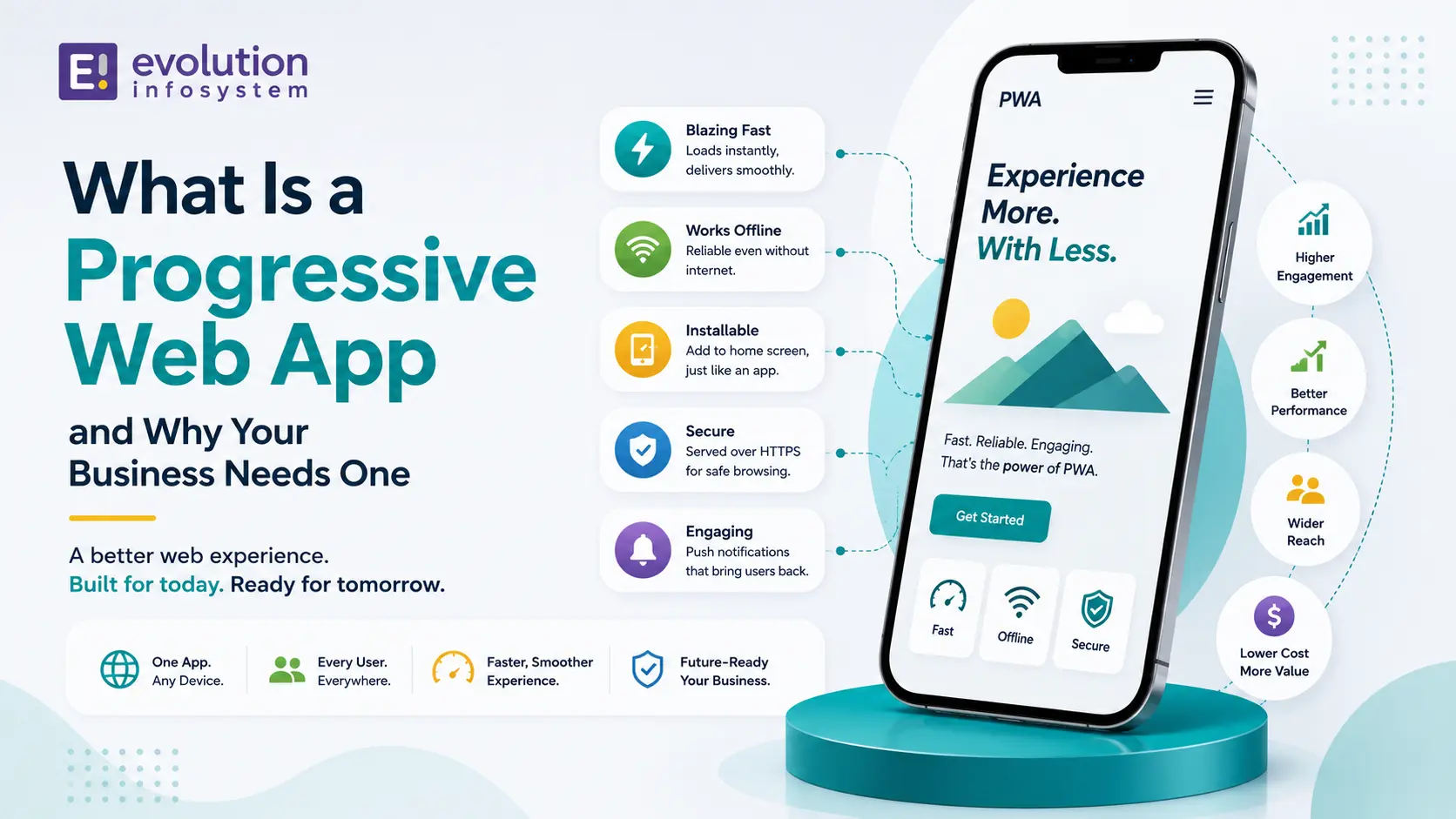
If your website takes more than three seconds to load on a phone, you are probably losing customers before they see anything you sell. That single problem is the starting point for understanding progressive web app benefits, and why so many businesses are quietly switching over in 2026 – not because it is trendy, but because the underlying performance and conversion numbers are hard to ignore once you see them.
A progressive web app, or PWA, is a website built to behave like a native app – installable, fast, and usable offline – without the cost or friction of building separate iOS and Android apps. This guide walks through what a PWA actually is, the concrete progressive web app benefits businesses are seeing in production, and how to decide if one fits your product.
We wrote this from an agency perspective. Evolution has built progressive web apps for e-commerce, service, and content-driven businesses, and this guide reflects what we have actually seen move the needle for clients, not just what a marketing page promises. By the end, you should know exactly which progressive web app benefits apply to your business and which do not, rather than a generic sales pitch either way.
Who This Guide Is For
This guide is for business owners weighing a PWA against a native app, marketers who keep hearing “PWA” and want a plain-language explanation, and developers who need a clear case to make to stakeholders. If you already understand the basics, jump ahead to the progressive web app benefits section for the business case. If you are starting from zero, read straight through – each section builds toward a decision you can actually act on.
What Is a Progressive Web App?
A progressive web app is a website built with standard web technologies – HTML, CSS, and JavaScript – that uses modern browser capabilities to behave like a native application. Users visit it through a normal browser, but can add it to their home screen, receive push notifications, and use core features even without an internet connection.
Three technical pieces make this possible: a service worker that caches content and enables offline use, a web app manifest that defines how the app appears when installed, and HTTPS, which is required for both. Together, these are the foundation underneath every progressive web app benefit covered in this guide.
Unlike a native app, there is no app store submission, no separate codebase per platform, and no forced update download – a PWA updates the moment you deploy a new version, and every user gets it automatically the next time they open it.
The Core Progressive Web App Benefits at a Glance
Before going deep into each one, here is a quick overview of the progressive web app benefits this guide covers in detail below.
- Faster load times, even on slow or unreliable connections
- Offline and low-connectivity functionality through service worker caching
- Installability without an app store, reducing friction to “download”
- Push notifications for re-engagement, without a native app
- Lower development cost than building separate iOS and Android apps
- Instant updates with no app store review delay
- Better discoverability, since PWAs are indexable by search engines like any website
- Improved conversion rates, driven by speed and app-like usability
Each of these progressive web app benefits solves a specific business problem. The sections below unpack why each one matters and what kind of results businesses have seen from them.
The Technology Behind Progressive Web App Benefits
Understanding the three technical building blocks behind every progressive web app benefit helps set realistic expectations for a build. None of these benefits happen automatically just by calling something a PWA.
Service Workers
A service worker is a background script that intercepts network requests, decides what to cache, and serves cached content when the network is unavailable or slow. This single piece of technology underpins the speed and offline-access progressive web app benefits almost entirely.
Web App Manifest
The manifest is a JSON file describing your app’s name, icons, theme color, and how it should launch when installed – full screen, standalone, or within the browser. This is what makes the installability benefit possible, giving your PWA a proper home screen presence.
HTTPS
Service workers only run on secure, HTTPS-served pages, both for security reasons and because they have significant power to intercept network traffic. Any site pursuing progressive web app benefits needs HTTPS as a non-negotiable prerequisite, not an optional nice-to-have.
How Progressive Web App Benefits Connect to Core Web Vitals
Google’s Core Web Vitals – Largest Contentful Paint, Interaction to Next Paint, and Cumulative Layout Shift – measure real-world loading and interaction speed, and they directly factor into search ranking. Many progressive web app benefits map closely onto these same metrics.
Service worker caching directly improves repeat-visit load times, which helps Largest Contentful Paint scores. A well-built PWA’s snappier interactions also tend to improve Interaction to Next Paint. This overlap means the SEO and performance progressive web app benefits are not separate wins – they reinforce each other through the same underlying technical work.
Security Considerations for Progressive Web Apps
Because a PWA requires HTTPS by default, it inherits a meaningful security benefit simply from that requirement – all traffic is encrypted, and service workers cannot run on tampered or unsecured connections. This is a quieter but real addition to the list of progressive web app benefits.
Push notification permissions and any stored offline data still need careful handling, since cached content sits on the user’s device. A well-built PWA should clear sensitive cached data appropriately and use secure token handling for any authenticated features, the same discipline any web application needs.
Progressive Web App Benefit #1: Speed
Speed is consistently the most cited of all progressive web app benefits, and for good reason. Modern users expect a page to load almost instantly; a delay of even a couple of seconds measurably increases bounce rate and abandoned carts.
Service worker caching lets a PWA store assets locally after the first visit, so returning users see near-instant load times on subsequent visits. This progressive web app benefit compounds directly into revenue for content and e-commerce sites, where speed correlates closely with time-on-site and conversion rate.
Progressive Web App Benefit #2: Offline and Low-Connectivity Access
Traditional websites fail completely without a live connection. One of the most distinctive progressive web app benefits is that a PWA keeps working, at least partially, when the network drops – cached pages remain viewable, and actions taken offline can sync once connectivity returns.
This matters more than it sounds. Commuters on patchy mobile networks, users in areas with inconsistent connectivity, and anyone stepping into a lift or elevator all benefit from an app that degrades gracefully instead of showing a blank error page.
Progressive Web App Benefit #3: Installability Without an App Store
A PWA can be added to a user’s home screen directly from the browser, with a single tap and no app store download. This is one of the more underrated progressive web app benefits, because it removes nearly every point of friction in the traditional app-install funnel.
There is no multi-hundred-megabyte download, no app store account requirement, and no waiting for a review process to approve your app before users can even try it. Once installed, a PWA looks and behaves like any other app icon on the device.
Progressive Web App Benefit #4: Push Notifications
Push notifications used to be exclusive to native apps. Now they are one of the standard progressive web app benefits, giving businesses a direct re-engagement channel without requiring a native app install first.
Used well, push notifications recover abandoned carts, announce restocks, and bring lapsed users back. Retailers who have added push notifications through a PWA commonly report meaningfully higher return visit rates among users who opt in, compared to those who do not.
Progressive Web App Benefit #5: Lower Development Cost
Building native apps for iOS and Android means maintaining two separate codebases, two release cycles, and two sets of platform-specific bugs. A single progressive web app benefit stands out clearly here: one codebase serves every device with a modern browser, cutting both initial build cost and ongoing maintenance considerably.
This does not mean PWAs are always cheaper than native apps in every scenario – for apps requiring deep hardware access, native remains necessary. But for most business, retail, and content applications, the cost savings from a single shared codebase is one of the most concrete progressive web app benefits a CFO will appreciate.
Progressive Web App Benefit #6: Instant Updates
Native app updates depend on users manually downloading a new version, often after a delay while the app store reviews the release. A PWA has no such gap – deploy a fix, and every user gets it the next time they open the app, with zero manual action required.
This progressive web app benefit is especially valuable for fixing bugs quickly or shipping time-sensitive features, since there is no fragmented user base still running an old version weeks after a fix has shipped.
Progressive Web App Benefit #7: Discoverability Through Search
Native apps live inside app stores, invisible to Google until someone actively searches that store. A PWA is a website first, which means it is fully indexable by search engines – every page can rank in organic search the same way any other web page can.
This progressive web app benefit is easy to overlook but genuinely significant: your PWA can bring in new customers through organic search traffic that a native app locked behind an app store simply cannot reach.
Progressive Web App Benefit #8: Higher Conversion Rates
All the progressive web app benefits above tend to compound into one measurable outcome: higher conversion. Faster loading, easier installation, offline resilience, and re-engagement through push notifications each remove a small piece of friction, and together they add up to meaningfully better business results.
Retailers that have switched to a PWA commonly report double-digit percentage increases in conversion rate and mobile engagement metrics. Results vary by industry and execution quality, but the pattern across case studies is consistent enough that this progressive web app benefit is rarely disputed.
Real Businesses, Real Results
Several well-known brands have publicly shared the progressive web app benefits they experienced after launching a PWA, and the numbers are worth understanding in context.
- A major e-commerce marketplace saw significantly higher conversion rates on its PWA versus its previous mobile site
- A leading electronics retailer in the Middle East reported far more sales from customers who opted into web push notifications
- A large ride-sharing platform built its booking experience as a PWA to keep the app lightweight on low-end devices and slow networks
- A global coffee retailer’s PWA lets customers browse and order even with a poor connection, then sync the order once connectivity returns
These examples make the abstract progressive web app benefits concrete: speed, offline resilience, and lower friction consistently translate into measurable business outcomes across very different industries.
Progressive Web App vs Native App: How to Decide
Not every business should choose a PWA over a native app, and a fair comparison means being honest about where native apps still win. Understanding this trade-off is essential before committing to any of the progressive web app benefits described above.
Choose a PWA When…
- Your primary goal is reach across web and mobile with one codebase
- Your budget favors a lower-cost build and maintenance path
- Your app does not require deep, continuous access to advanced device hardware
- You want organic search visibility as part of your acquisition strategy
Choose a Native App When…
- Your product depends on intensive hardware use, like advanced camera processing or high-performance gaming
- You need the deepest possible integration with platform-specific features
- App store presence itself is a core part of your discovery and marketing strategy
- Your users strongly expect the polish and platform conventions of a fully native experience
Many businesses do not have to choose exclusively – building a PWA first, then adding a native app later if a specific hardware need justifies it, is a common and sensible sequencing that captures most progressive web app benefits early without closing off the native option.
Which Industries Benefit Most from a PWA?
Some business types see progressive web app benefits more directly than others, based on how their customers shop and browse.
E-Commerce and Retail
Offline product browsing, persistent cart data, and push notifications for restocks and deals make PWAs a strong fit for online retail, where every second of load time affects conversion directly.
Media and Content Publishers
Offline article and video access, fast progressive loading, and easy social sharing all play to a PWA’s strengths, especially for publishers whose audience reads on the go.
Travel and Hospitality
Travelers frequently browse and book with unreliable connectivity – in airports, on flights, or abroad – making offline resilience one of the more valuable progressive web app benefits for this industry specifically.
Service and Local Businesses
A local business offering booking, quotes, or account management benefits from a PWA’s low-friction installability, letting customers “install the app” without ever touching an app store.
Common Mistakes When Building a PWA
Mistake 1: Treating It as Just a Website With an Icon
A PWA that skips proper service worker caching and offline handling captures almost none of the real progressive web app benefits – it is just a website with a shortcut, not a genuinely resilient app-like experience.
Mistake 2: Ignoring the Install Prompt Experience
Browsers control when and how the install prompt appears. Poorly timed or overly aggressive prompts frustrate users and reduce install rates, undercutting the installability benefit before it can help.
Mistake 3: Skipping Performance Auditing After Launch
Speed-related progressive web app benefits erode over time as a codebase grows, unless a team keeps auditing performance with tools like Lighthouse and addressing regressions before they compound.
Mistake 4: Underestimating iOS Limitations
iOS Safari historically supported fewer PWA capabilities than Android Chrome, particularly around push notifications and background sync. This gap has narrowed but has not fully closed, so plan for platform-specific testing rather than assuming feature parity.
Mistake 5: Not Promoting the Install Option
Even a well-built PWA sees low adoption if customers never learn they can install it. Add a visible, well-timed install prompt or a simple banner explaining the option – most of the progressive web app benefits only reach users who actually install or bookmark the app.
How to Build a Progressive Web App: The Basic Process
Turning an existing site into a PWA, or building one from scratch, generally follows the same core sequence.
- Audit your current site for HTTPS, responsive design, and performance baseline
- Create a web app manifest defining your app’s name, icons, and display behavior
- Implement a service worker to handle caching and offline functionality
- Add push notification support if re-engagement is part of your strategy
- Test installability and performance across both Android and iOS devices
- Audit and optimize using Lighthouse before and after launch
The technical implementation is straightforward for experienced web development teams, but realizing the full set of progressive web app benefits requires getting the caching strategy and offline behavior right, not just checking the manifest and service worker boxes.
Cost Considerations
One of the clearest progressive web app benefits is cost, but it is worth being specific about where the savings come from. Building one codebase instead of separate iOS and Android native apps typically cuts both initial development cost and the ongoing cost of maintaining multiple platforms in parallel.
Maintenance savings compound over time: a single bug fix or feature addition ships once, rather than being built, tested, and released separately for each native platform. For growing businesses watching every rupee of development budget, this progressive web app benefit often outweighs the others in practical importance.
How to Measure Whether Your PWA Is Delivering Results
Claiming progressive web app benefits without measuring them is a missed opportunity. Track these metrics before and after launch to know whether your PWA is actually performing.
- Load time and Core Web Vitals scores, using tools like Lighthouse or PageSpeed Insights
- Install rate: what percentage of visitors add the PWA to their home screen
- Push notification opt-in and click-through rate
- Return visit frequency for installed users versus non-installed visitors
- Conversion rate segmented by installed versus browser-only sessions
Without this data, it is easy to assume progressive web app benefits are happening simply because the technology is in place. Measuring these numbers directly is what turns an assumption into a validated business case you can bring back to stakeholders.
Testing a PWA Properly Before Launch
A PWA needs testing across more scenarios than a typical website, since offline behavior and installability both need explicit verification, not just visual QA in a browser at full connectivity.
- Test the install flow on both Android Chrome and iOS Safari, since behavior differs between them
- Simulate offline mode in browser dev tools to confirm cached pages and graceful fallbacks work as expected
- Verify push notifications render and deep-link correctly on real devices, not just simulators
- Run a Lighthouse audit specifically against the PWA checklist, not just general performance
Skipping this testing phase is one of the fastest ways to ship a PWA that technically qualifies as one but fails to deliver the progressive web app benefits customers actually notice.
Where Progressive Web Apps Are Headed
The gap between what native apps and PWAs can access on a device has narrowed significantly. Modern browser APIs now expose biometric authentication, camera, GPS, and even some Bluetooth capabilities to web apps, expanding the list of practical progressive web app benefits every year.
AI-driven personalization and smarter offline data synchronization are also becoming standard expectations for PWAs rather than advanced features, which suggests the gap with native apps will keep narrowing rather than widening in the years ahead.
What Happens If You Skip This Decision Entirely
Some businesses avoid the PWA-versus-native decision altogether by doing nothing – keeping a slow, non-installable mobile website while competitors adopt faster, app-like experiences. This is a real cost, even though it does not show up as a line item anywhere.
Every quarter spent without addressing mobile speed and installability is a quarter of lost progressive web app benefits, measured in abandoned carts, shorter session times, and customers who quietly switch to a competitor’s faster site. Treating this as a “someday” project rather than a near-term priority is itself a decision, just an implicit one.
Budgeting and Planning a PWA Project
Once a business decides to pursue the progressive web app benefits covered in this guide, planning realistically means accounting for a few distinct phases: an audit of the existing site, manifest and service worker implementation, push notification infrastructure if needed, and a testing phase across both major mobile platforms.
Businesses converting an existing, well-maintained site into a PWA typically see a faster, lower-cost path than those building a new site and a PWA simultaneously. If your current site has significant technical debt, it is often worth addressing that first, since a PWA built on top of a slow, poorly structured site will not deliver its full potential progressive web app benefits regardless of how well the service worker is configured.
Frequently Asked Questions (FAQs)
What is the main benefit of a progressive web app?
Speed and installability are usually cited as the two most immediate progressive web app benefits, since they directly and quickly affect how users experience and engage with your site.
Do progressive web apps work on iPhone?
Yes, modern versions of iOS Safari support PWAs, including home screen installation and offline caching, though some advanced features like background sync remain more limited on iOS than on Android.
Is a PWA cheaper than a native app?
Generally yes, since a PWA uses a single codebase across platforms instead of separate native builds for iOS and Android, reducing both build and maintenance cost in most cases.
Can a progressive web app replace my native app entirely?
For many business, retail, and content use cases, yes. For apps requiring deep hardware access or heavy processing like advanced gaming, native still has an edge, so the right answer depends on your specific product requirements.
How long does it take to build a PWA?
A straightforward PWA conversion of an existing, well-built website can take a few weeks. A more complex build from scratch, with custom offline logic and push notification infrastructure, typically takes longer depending on scope.
Does a PWA help with SEO?
Indirectly, yes. A PWA is fully indexable like any website, and the speed improvements central to progressive web app benefits also align closely with Google’s Core Web Vitals, which factor into search ranking.
Can I convert my existing website into a PWA?
In most cases, yes. If your site already runs on HTTPS and follows reasonably modern web standards, adding a service worker and web app manifest is usually enough to unlock most progressive web app benefits without a full rebuild.
Do I still need to submit a PWA to app stores?
No, that is one of the core progressive web app benefits – users install directly from the browser. Some businesses choose to also list a wrapped version in app stores for extra discoverability, but it is optional, not required.
Accessibility and Reach Beyond Speed
A less-discussed piece of the progressive web app benefits picture is reach. Because a PWA runs in any modern browser, it works on devices and operating systems a native app roadmap might otherwise deprioritize – older Android phones, budget devices, and desktop browsers alike, all from the same codebase.
This matters in markets with a wide spread of device capability, where a native app optimized only for flagship phones can quietly exclude a meaningful share of potential customers. A PWA’s progressive enhancement approach – working adequately everywhere and exceptionally well where the hardware allows – is baked into its design philosophy, not bolted on afterward.
Common Objections to PWAs, Addressed
A few objections come up repeatedly when businesses first hear about progressive web app benefits, and they deserve honest answers rather than being waved away.
- “Our users expect an app store listing” – true for some categories, but increasingly less true for utility, retail, and service apps where users just want fast access
- “PWAs feel less polished than native” – largely outdated; modern PWAs built with attention to detail are visually indistinguishable from native apps for most users
- “We already have a native app, why bother” – a PWA can complement an existing native app by capturing the browser-first segment of your audience that never downloads apps at all
- “iOS support is too limited” – true historically, but the gap has narrowed enough that most core progressive web app benefits now work acceptably well on iOS too
None of these objections are baseless, but none of them are decisive reasons to skip a PWA either. They are simply factors to weigh honestly against your specific product and audience.
Key Takeaways
- A PWA is a website that behaves like a native app: installable, fast, and usable offline
- The core progressive web app benefits are speed, offline access, installability, push notifications, lower cost, instant updates, discoverability, and higher conversion
- Real businesses across e-commerce, retail, and travel have reported measurable gains from these benefits
- PWAs are not a universal replacement for native apps, especially for hardware-intensive products
- Getting the technical implementation right – caching, offline handling, manifest configuration – is what actually unlocks these benefits
Each of these points reflects a pattern that shows up repeatedly across real PWA launches, which is exactly why understanding progressive web app benefits properly, rather than treating a PWA as a trendy checkbox, matters before you commit budget to one.
A Quick Example: Evaluating a PWA for a Regional Retailer
Picture a Gujarat-based furniture retailer with a growing online catalog and a mobile site that loads slowly on customers’ phones. Walking through the progressive web app benefits above, three stand out immediately for this business: speed, installability, and push notifications for new arrivals and sale announcements.
The retailer does not need deep hardware access or complex device integration, so a native app would add cost without a matching benefit. A PWA lets them ship one codebase that works across desktop and mobile browsers, install directly to a customer’s home screen, and send push notifications for new collections – capturing most of the meaningful progressive web app benefits without the overhead of maintaining separate iOS and Android apps.
Three months after launch, the retailer tracks install rate, push opt-in rate, and mobile conversion rate segmented by installed users versus browser-only visitors – exactly the measurement approach described earlier in this guide, turning the theoretical progressive web app benefits into a data-backed business case.
Why the Development Partner Matters as Much as the Technology
The progressive web app benefits covered throughout this guide are only as real as the implementation behind them. A rushed service worker setup, a poorly timed install prompt, or skipped offline testing can quietly undercut every benefit on this list, even while the site technically qualifies as a PWA.
When evaluating a development partner, ask to see Lighthouse scores from their previous PWA builds, and ask specifically how they handle offline data conflicts and push notification infrastructure – not just whether they have “built a PWA before.” The difference between a PWA that delivers real business results and one that technically checks the boxes usually comes down to exactly this kind of implementation detail.
Final Thoughts
A progressive web app is not a fad – it is a practical way to deliver a fast, installable, resilient experience without the cost and friction of maintaining separate native apps. The progressive web app benefits covered here – speed, offline access, lower cost, and higher conversion – are consistent enough across industries that most businesses should at least evaluate the option seriously.
If you are weighing a PWA against a fully native build, our progressive web apps vs native apps decision guide goes deeper into that specific trade-off and can help you reach a confident answer for your product.
Evolution’s web development and mobile app development teams build progressive web apps end to end – from service worker architecture to push notification setup – and we are happy to assess whether a PWA is the right fit for your specific business before you commit to a build.