What to Look for When Hiring a Software Development Company
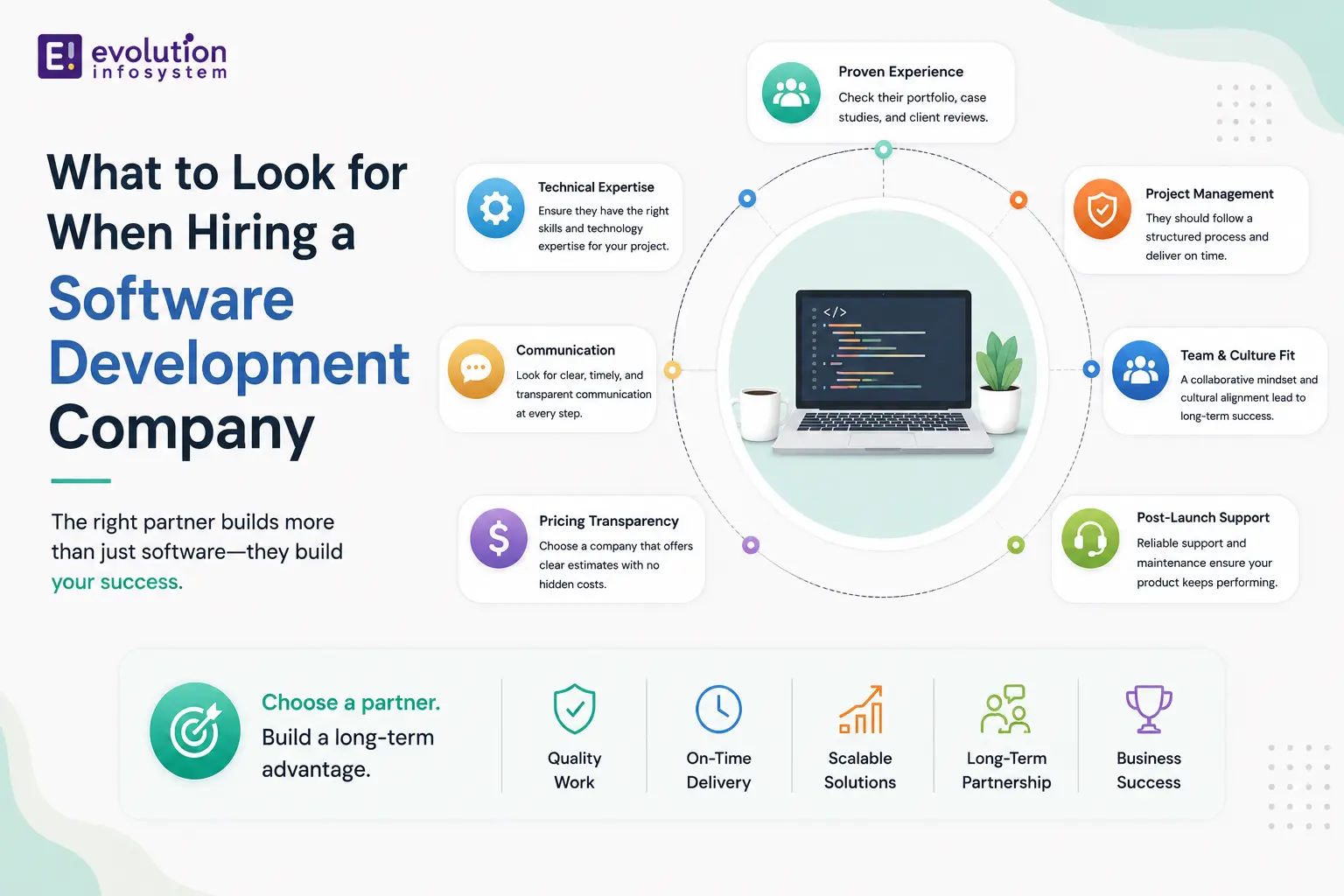
Hiring a software development company is one of the highest-stakes vendor decisions a business makes. Done well, it accelerates your product roadmap, extends your technical capability, and brings outside expertise that compounds over time. Done poorly, it produces missed deadlines, technical debt, communication breakdowns, and a codebase you’ll spend months untangling.
The companies that consistently make good choices here aren’t lucky. They evaluate systematically – not just on portfolio and rates, but on process maturity, communication quality, and cultural fit. Here’s the framework.
Technical Capability: Look Deeper Than the Portfolio
Every software development company shows you its best work. The portfolio is a marketing asset, not an evaluation tool. What the portfolio tells you is whether the company has worked in your domain and at roughly your scale. What it doesn’t tell you is anything about how that work was done, how many iterations it took, or what the client experience was like.
To evaluate technical capability properly, go deeper:
→ Ask about a project that went wrong.
How a development company talks about past failures tells you more than how they talk about successes. A company that has handled a difficult project honestly – identified what went wrong, changed their process as a result, and can explain it clearly – is a company with real operational experience. A company that struggles to name a challenge or deflects with vague generalities probably hasn’t done enough work to have meaningful failures, or isn’t honest about the ones they have.
→ Review real code.
For any serious engagement, request a code review of work from a relevant previous project. This reveals more about engineering quality – naming conventions, test coverage, architecture clarity, documentation standards – than any case study.
→ Ask about their AI and tooling practices.
Today, development teams that have integrated AI-assisted development tools (GitHub Copilot, Cursor, or equivalents) into their workflow ship faster. Teams that haven’t are at a velocity disadvantage. Ask specifically how they use AI tools in development and what impact they’ve seen on delivery speed and quality.
→ Assess architecture thinking.
Give the team a simplified version of your product’s core technical challenge and ask how they’d approach it. You’re not looking for the perfect answer – you’re looking for the quality of the reasoning.
Do they ask clarifying questions?
Do they consider trade-offs?
Do they explain their thinking clearly?
Poor architectural judgment in a discovery conversation predicts poor architectural judgment in production.
Process Maturity: How They Work Is What You’ll Live With
Technical capability gets work done. Process maturity determines whether that work is delivered predictably, communicates status accurately, and adapts gracefully when requirements change. Most client-development company relationships that fail don’t fail because of insufficient technical skill – they fail because of process breakdowns.
→ Requirements and discovery.
Before any development starts, how does the company approach requirements?
Do they run a structured discovery phase – asking hard questions about your users, your business constraints, and your technical context – or do they jump straight to an estimate and a start date?
Companies that skip rigorous discovery produce estimates that are wrong and requirements that are incomplete.
→ Sprint structure and delivery rhythm.
What does a typical sprint look like?
How frequently does the client see working software?
Two-week sprint cycles with a demo and a working build at the end of each cycle is the baseline expectation. Longer cycles without visible output are a risk – both for delivery predictability and for catching misalignment before it compounds.
→ Change management.
Requirements change. How does the company handle scope changes mid-engagement?
A clear, fair change request process – documented, priced, and approved before execution – is a sign of a mature operation. Companies that either resist scope changes rigidly or absorb them without any formal process both create problems.
→ Testing and QA.
What is the company’s approach to quality assurance?
Is testing integrated into development – unit tests, integration tests, automated regression – or is it a separate phase at the end?
Bolted-on QA finds bugs late, when they’re expensive to fix. Integrated testing finds them early.
Communication: The Variable Most Companies Underestimate
Communication quality is the single most predictive variable for a successful development engagement – and the one most commonly underweighted during evaluation.
→ Response time and clarity.
During the sales process, how quickly do they respond to questions?
How clearly do they communicate?
The behavior you see during the sales process is the best available predictor of behavior during the engagement. A company that takes 48 hours to respond to a pre-sales question will take 48 hours to respond to a production issue.
→ Proactive escalation.
Does the company proactively communicate problems, or do you have to discover them?
The most reliable development partners flag issues – timeline risks, technical blockers, scope ambiguities – as soon as they’re identified, not when they’ve already become crises. Ask specifically how they handled a situation where something was going off-track on a client project.
→ Single point of contact.
Is there a consistent project manager or account lead who owns the client relationship and has visibility into delivery?
Or does communication go directly to individual developers with no coordination layer?
The former scales. The latter fragments.
→ Time zone and language.
For distributed engagements, assess communication quality in the overlap window. A development team with strong English communication capability and genuine overlap time with your working hours is substantively different – in terms of daily operational experience – from one where communication is fragmented across asynchronous messages with significant language barriers.
Red Flags to Eliminate Early
Some signals should end an evaluation conversation immediately:
→ Estimates that arrive too quickly.
A software development company that provides a detailed estimate for a complex project within 24 hours of receiving a brief hasn’t thought carefully about the problem. Real estimates require questions, clarifications, and technical assessment. Fast estimates are guesses dressed up as commitments.
→ Unwillingness to provide references.
Every development company with real client relationships should be able to provide at least two or three references willing to take a call. If references aren’t available, there’s a reason.
→ Vague answers about team composition.
Who will actually be working on your project?
What are their seniority levels?
Will the team change mid-engagement?
Companies that are vague about team composition are often managing high developer turnover or running a bait-and-switch – selling with senior talent and delivering with junior developers.
→ No ownership of past failures.
As covered above, a company that can’t describe a project that went wrong isn’t trustworthy. Either they haven’t done enough work to have failures, or they’re unwilling to be honest about them. Neither is what you want in a long-term technical partner.
→ Lock-in architecture.
Be wary of companies that build in ways that create dependency – proprietary frameworks, non-standard deployment approaches, or architectures that would be difficult and expensive for another team to maintain or extend. Your codebase should be yours, fully, at the end of the engagement.
The Evaluation Process That Works
A practical evaluation sequence for selecting a software development company:
Step 1. Shortlist 3–5 companies based on domain experience, portfolio relevance, and company scale relative to your project.
Step 2. Send a structured brief. Not a request for proposal – a clear description of your product, your goals, your constraints, and your timeline expectations. Evaluate the quality of the questions they ask in response.
Step 3. Run a technical discovery call with the team lead or architect who would actually work on your project – not the sales team. Assess technical thinking directly.
Step 4. Request a code sample or architecture proposal for a simplified version of your core challenge.
Step 5. Speak to two client references. Ask specifically: what went wrong, how did the company handle it, and would you hire them again?
Step 6. Evaluate the contract carefully. IP ownership, source code handover provisions, confidentiality, and termination clauses matter as much as the commercial terms.
At Evolution Infosystem, we welcome this level of evaluation. We’ll give you references, talk honestly about what’s gone wrong on projects and what we learned from it, walk you through our architecture thinking, and show you real code. If you’re evaluating development partners and want to add us to your shortlist, let’s talk.
Frequently Asked Questions (FAQs)
How do I evaluate a software development company’s technical capability?
Go beyond the portfolio. Request a code review from a previous project, ask about a project that went wrong and how it was handled, assess architecture thinking by presenting a simplified version of your technical challenge, and ask specifically about their AI-assisted development practices and tooling.
What are the red flags when hiring a software development company?
Estimates delivered too quickly without sufficient discovery, unwillingness to provide client references, vague answers about who will actually work on your project, inability to describe a past project failure honestly, and architectural choices that create lock-in to the vendor.
How important is communication when hiring a dev company?
Extremely important – arguably more predictive of engagement success than technical capability alone. Evaluate response time, clarity, and proactive communication during the sales process. The behavior you see before signing the contract is the best available signal for behavior during delivery.
Should I hire a local or offshore software development company?
The decision should be based on capability, process maturity, and communication quality – not geography. Today, the strongest offshore development companies operate with process maturity, English communication capability, and overlap time management that makes the geographic difference largely irrelevant for most product categories.