BLE Development: Use Cases, Architecture, and When Bluetooth Low Energy Is the Right Choice
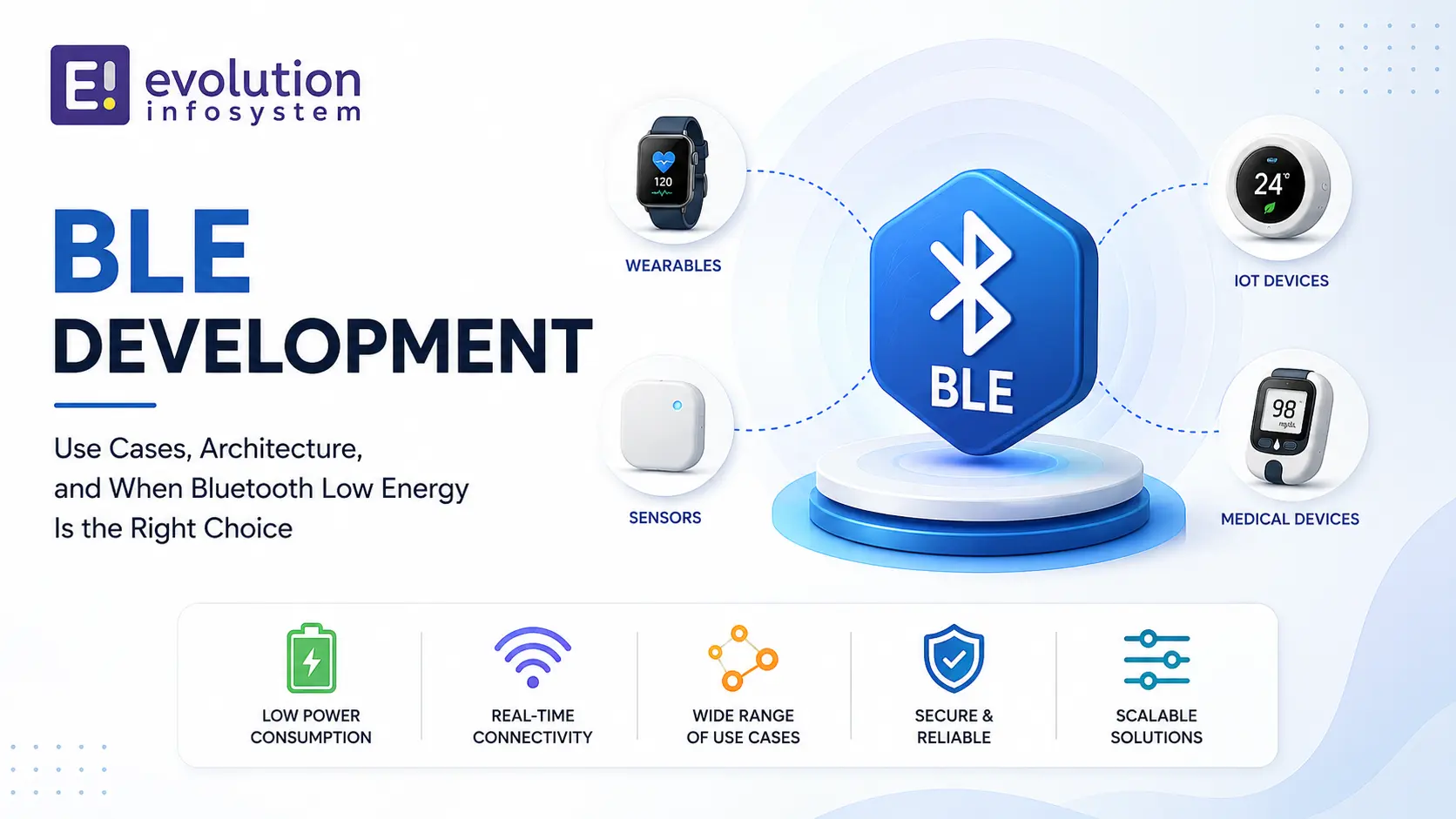
Bluetooth Low Energy is one of the most widely deployed wireless technologies in the world – and one of the most misunderstood. Most developers encounter it through consumer products (AirPods, fitness trackers, smart locks) without understanding the protocol that powers them. Most businesses encounter it as a capability they know exists but can’t clearly scope into a project.
BLE development has a defined set of use cases where it’s the correct technical choice. Understanding those use cases, the underlying architecture, and the development patterns that make BLE work reliably in production will help you evaluate whether BLE solves your specific problem – and how to build it right if it does.
What BLE Is and How It Differs From Classic Bluetooth
Bluetooth Low Energy (BLE), introduced in Bluetooth 4.0 in 2010, is a fundamentally different protocol from Classic Bluetooth, designed for a different class of use cases.
→ Classic Bluetooth is designed for continuous, high-bandwidth data transfer: streaming audio to headphones, transferring files between devices, connecting keyboards and mice. Power consumption is relatively high because the connection is continuous.
→ BLE is designed for intermittent, low-bandwidth data exchange between devices that need to run on small batteries for months or years. A BLE sensor can transmit a temperature reading every 30 seconds and run on a coin cell battery for two years. The same use case on Classic Bluetooth would drain the battery in days.
The trade-off is bandwidth. BLE’s maximum data throughput is approximately 1 Mbps (Bluetooth 4.x) to 2 Mbps (Bluetooth 5.x) – adequate for sensor data, small file transfers, and configuration commands, but not for audio streaming or large file transfer.
Key BLE capabilities introduced in Bluetooth 5.x:
- Extended range: up to 400 metres in open space (from ~100m in BT 4.x) with Long Range mode
- Higher throughput: 2 Mbps mode for applications needing faster data transfer
- Direction finding: angle of arrival and angle of departure for precise indoor positioning (sub-metre accuracy)
- Increased advertising data: 255 bytes vs 31 bytes in BT 4.x, enabling richer broadcasting
The GATT Protocol: How BLE Communication Works
Understanding GATT (Generic Attribute Profile) is essential for BLE development because it defines how devices communicate once connected.
Roles:
- Peripheral: the device that advertises and provides data (a heart rate monitor, a temperature sensor, a lock)
- Central: the device that scans for peripherals, connects to them, and reads or writes their data (a smartphone, a tablet, a gateway device)
Structure:
- Services: logical groupings of related functionality. A heart rate monitor exposes a Heart Rate Service. A temperature sensor exposes an Environmental Sensing Service.
- Characteristics: individual data values within a service. The Heart Rate Service contains a Heart Rate Measurement characteristic.
- Descriptors: metadata about characteristics – whether they’re readable, writable, notifiable.
Interaction patterns:
- Read: the central requests the current value of a characteristic
- Write: the central sends a value to the peripheral
- Notify: the peripheral pushes updates to the central when the value changes (without the central polling)
- Indicate: like Notify but with acknowledgement
The practical importance of GATT design: A well-designed GATT profile minimises connection time and data transfer. A poorly designed one keeps connections open longer than necessary, draining battery on both devices. BLE development that doesn’t account for GATT efficiency produces devices that underperform their battery specifications.
Real Use Cases: Where BLE Development Delivers Value
Asset Tracking
BLE beacons – small, battery-powered devices that broadcast their identifier at defined intervals – enable real-time location tracking of assets within a facility without GPS (which doesn’t work indoors) and without Wi-Fi (which is overkill for simple tracking).
→ How it works: BLE beacons are attached to assets (medical equipment in hospitals, tools on construction sites, retail inventory, equipment in warehouses). Gateways (fixed BLE scanners on the ceiling or walls) detect beacon signals and report location data to a cloud backend. The asset’s location is determined by which gateways can detect it and at what signal strength.
→ Production deployments: Hospital asset tracking with BLE has documented 20–30% reductions in time nurses spend searching for equipment. Construction tool tracking reduces theft and misplacement losses measurably. Warehouse pallet tracking improves inventory accuracy.
→ Bluetooth 5.1+ direction finding enables sub-metre accuracy tracking using angle of arrival calculation – a significant improvement over the room-level accuracy of signal-strength-based positioning.
Health Device Integration
Fitness trackers, smartwatches, continuous glucose monitors, blood pressure cuffs, pulse oximeters, and medical-grade monitoring devices all communicate with mobile applications via BLE using standardised Bluetooth SIG health profiles.
Building a mobile app that connects to health devices requires implementing the appropriate GATT profiles (Heart Rate Profile, Blood Pressure Profile, Glucose Profile) and handling the pairing, connection management, and data parsing that the device communicates.
Key considerations for health BLE development: connection reliability (medical applications cannot tolerate dropped readings), background BLE operation (iOS and Android both restrict background BLE differently), and data integrity (health data must be correctly parsed from the binary GATT characteristic format).
Proximity Marketing and Retail Analytics
iBeacon (Apple) and Eddystone (Google) are BLE beacon standards that enable location-based marketing triggers in retail environments. When a customer’s smartphone detects a beacon, the retailer’s app can trigger a relevant notification, offer, or content piece.
Retail applications:
- Welcome notification when a loyalty customer enters the store
- Product-specific offer when a customer lingers near a display
- Navigation assistance in large retail spaces
- Queue management (notify customers of available service points)
Analytics applications: Even without app interaction, beacon detection data from opted-in devices provides foot traffic heatmaps, dwell time analysis, and conversion rate measurement between departments.
The requirement for an installed app with location permissions has limited the adoption of proximity marketing at scale – but for retailers with strong loyalty apps and high app penetration, BLE proximity remains one of the more precise customer engagement tools available.
Industrial Sensor Connectivity
BLE sensors measuring temperature, humidity, pressure, vibration, and gas concentration connect to mobile apps and gateway devices for real-time industrial monitoring.
→ Cold chain monitoring: BLE temperature sensors inside refrigerated containers transmit continuous readings to a gateway. Alerts fire when temperature exceeds safe thresholds. The data provides a complete temperature history for regulatory compliance.
→ Equipment monitoring: BLE vibration sensors on industrial equipment detect anomaly patterns. BLE is the right protocol here because sensors are battery-powered, in locations without power outlets, and don’t require continuous high-bandwidth data transfer.
Smart Access Control
BLE-based access control allows smartphones and wearables to unlock doors, gates, and equipment. The user’s device connects to the lock via BLE, authenticates, and triggers the unlock. This is the technology behind hotel digital keys, office access systems, and automotive digital keys on supported vehicles.
The development challenge is security: a BLE access control system must implement robust cryptographic authentication to prevent relay attacks and unauthorised access. Poorly secured BLE access systems have well-documented vulnerabilities. Any BLE access control implementation needs a rigorous security review.
BLE Development: Platform Considerations
iOS BLE development:
- Core Bluetooth framework handles all BLE operations
- Background BLE operation is restricted – iOS apps can only scan or connect in the background with specific usage declarations and limitations
- iOS 13+ requires user permission for Bluetooth access
- Central and peripheral modes both supported
Android BLE development:
- Android provides the BluetoothGatt API for BLE operations
- Background BLE is less restricted than iOS but varies by Android version and manufacturer
- Android 12+ requires separate BLUETOOTH_SCAN and BLUETOOTH_CONNECT permissions
- Android’s BLE stack has historically had more variability across manufacturers – thorough testing on multiple real devices is essential
→ Cross-platform considerations: React Native and Flutter both have BLE libraries (react-native-ble-plx, flutter_blue_plus) that abstract platform differences. For apps primarily interacting with BLE devices without deep platform-specific BLE features, cross-platform development is viable. For complex BLE implementations with specific background requirements, native development gives more control.
Frequently Asked Questions (FAQs)
What is BLE development?
BLE (Bluetooth Low Energy) development is building mobile applications, embedded firmware, or gateway software that communicates using the Bluetooth Low Energy protocol. It involves implementing the GATT (Generic Attribute Profile) protocol for structured data exchange between a central device (typically a smartphone) and peripheral devices (sensors, beacons, medical devices, locks).
What is the range of BLE?
Bluetooth 4.x BLE has a range of approximately 10–100 metres depending on environment and hardware. Bluetooth 5.x increased range to up to 400 metres with Long Range mode. In practice, real-world range is significantly less than maximum specification due to walls, interference, and body blocking. Indoor asset tracking typically plans for 10–30 metre reliable coverage per gateway.
What is the difference between iBeacon and Eddystone?
Both are BLE beacon standards that broadcast an identifier. iBeacon is Apple’s standard, supported by iOS and Android. Eddystone is Google’s open standard, also supported by both platforms. iBeacon broadcasts a UUID, major, and minor value; Eddystone supports multiple frame types including UID, URL, and encrypted telemetry. For most proximity marketing applications, both work similarly in practice.
Can BLE work without an app?
Yes, in limited scenarios. Eddystone-URL beacons can trigger Chrome on Android to display a URL notification without a dedicated app installed (Physical Web). But for any meaningful interaction – unlocking, tracking, health data reading – an installed app is required. The app-dependency is the primary adoption barrier for consumer-facing BLE applications.
How accurate is BLE for indoor positioning?
Signal-strength-based BLE positioning (RSSI) provides room-level accuracy – roughly 2–5 metres. Bluetooth 5.1 direction finding (Angle of Arrival) provides sub-metre accuracy but requires purpose-built antenna arrays at access points. For most asset tracking use cases, room-level accuracy is sufficient. For precise positioning (robotics, surgical instruments), direction finding or UWB (Ultra-Wideband) are more appropriate.
At Evolution Infosystem, we build BLE applications for asset tracking, health device integration, proximity marketing, and industrial monitoring – on iOS, Android, and cross-platform. We design GATT profiles correctly from the start, handle background BLE edge cases across platforms, and build the cloud backend that makes BLE data actionable. Let’s talk about your BLE project.