iOS vs Android: Which Platform Should You Build Your App On First?
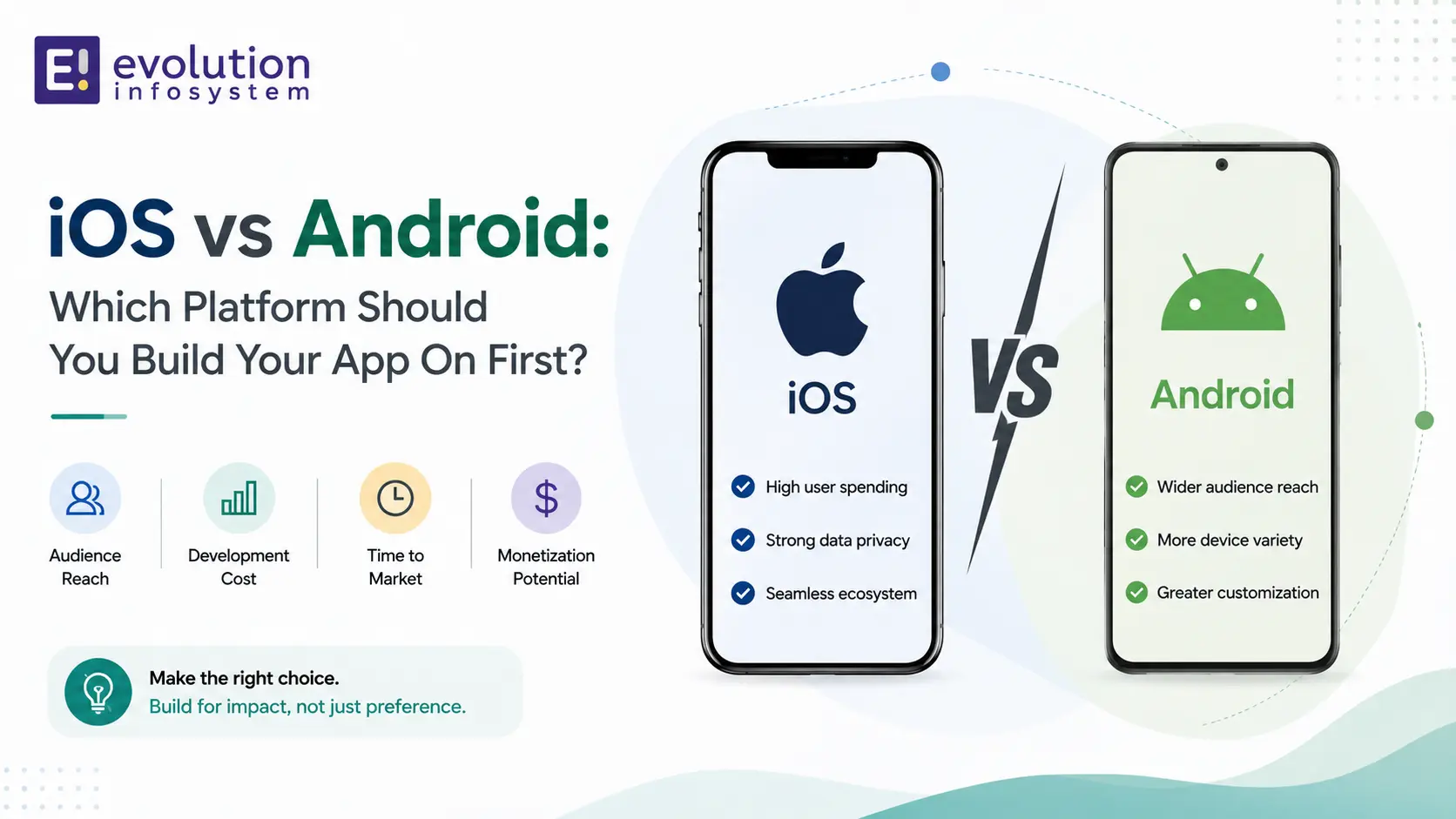
Every mobile app project eventually hits the same question: iOS first, Android first, or both simultaneously? The wrong answer costs you months of misaligned development and a product launched to the wrong audience.
The right answer is never universal. It depends on five factors specific to your product, your market, and your business model. Get these five factors right and the platform decision becomes obvious.
Why This Decision Matters More Than Most Teams Think
Building for both platforms simultaneously sounds ideal. In practice, it splits engineering focus, doubles QA complexity, and often means neither platform gets the attention it deserves. Most teams – particularly early-stage products and startups – are better served by launching on one platform exceptionally well than launching on both platforms adequately.
The platform you launch on first shapes your early user base, your initial feedback quality, and your product’s perception in the market. iOS vs Android app development isn’t just a technical decision – it’s a product strategy decision.
Factor 1: Where Is Your Target Audience?
This is the most important variable. Platform preference varies dramatically by geography.
→ iOS dominates in: the United States, the United Kingdom, Canada, Australia, Japan, Scandinavia, and Western Europe. In the US, iOS holds approximately 57% of the smartphone market. In Japan, it exceeds 65%.
→ Android dominates in: India, Southeast Asia, South America, Africa, Eastern Europe, and most of the developing world. Android’s global market share exceeds 72%. In India, it exceeds 95%.
If your primary market is the US, UK, or Australia – iOS first. Your early adopters, your reviewers, and your press coverage will skew heavily iOS. If your primary market is India, Southeast Asia, or any emerging market – Android first, without question.
If you’re targeting a global audience from day one, the platform split in your specific vertical matters more than global averages. Check your competitors’ app store presence and ratings volume. Where are their reviews concentrated? That tells you where the active users in your category are.
Factor 2: What Is Your Revenue Model?
iOS users spend significantly more on apps than Android users. The gap is consistent across virtually every app category.
→ For subscription-based apps: iOS users convert to paid subscriptions at higher rates and churn less. If your business model depends on in-app subscriptions – productivity tools, fitness apps, content platforms – iOS revenue per user is meaningfully higher.
→ For in-app purchase models: The same applies. iOS users spend more on in-app purchases across gaming, education, and entertainment categories.
→ For free apps monetised through advertising: Android’s larger user base becomes more relevant. Ad CPMs (cost per thousand impressions) are lower on Android, but the volume of Android users in some markets compensates.
→ For B2B and enterprise apps: iOS tends to dominate enterprise device management programs, particularly in North American and European enterprises. iPhones are the default corporate device in most large organisations in these markets.
If your revenue depends on user spending, iOS first. If your revenue depends on volume and advertising, geography and audience composition matter more than the platform itself.
Factor 3: What Type of App Are You Building?
→ Consumer apps targeting mass market demographics: Consider Android’s global reach seriously. If your addressable market is genuinely global – a messaging app, a utility, an education product for students – the sheer volume of Android devices gives you access to a larger total market.
→ Premium consumer apps, lifestyle, or creative tools: iOS. The demographic concentration of higher-income, premium-spending users on iOS is well-documented.
→ Healthcare apps: iOS. Apple’s HealthKit, ResearchKit, and health sensor APIs are more mature and permissive than Android Health equivalents. The US healthcare market, where HIPAA compliance is standard, skews iOS heavily.
→ Fintech and banking apps: iOS for Western markets, Android for emerging markets. Mobile banking in India and Africa runs predominantly on Android.
→ Gaming: Both, but Android has higher user numbers at lower monetisation. If your game is premium-priced, iOS. If it’s free-to-play with in-app purchases at high volume, consider Android’s market depth.
→ Enterprise and B2B tools: iOS first for North American and European enterprises. Android where corporate mobile programs are less standardised.
Factor 4: How Fast Do You Need to Move?
iOS development has some practical speed advantages in early-stage product development:
→ Smaller device fragmentation. Apple controls both the hardware and the software. There are a limited number of iPhone models to test against. Android has thousands of device models, screen sizes, OS versions, and manufacturer customisations. QA on Android takes longer.
→ App Store review times. Both stores have automated much of their review process, but iOS App Store reviews are more predictable. Android’s Google Play review can be faster for initial submissions but has its own delays for policy changes.
→ SwiftUI development velocity. For experienced iOS developers, SwiftUI enables rapid UI iteration. The tooling (Xcode, Swift) is mature and well-integrated.
If speed to market is a primary constraint, iOS is typically faster to a high-quality launch. Android’s fragmentation means more testing time for equivalent quality.
Factor 5: What Does Your Technical Team Know?
This is the pragmatic factor that often gets overlooked in platform strategy discussions.
A team with deep Swift and iOS expertise will build a better iOS app faster than an equally skilled team forced to learn Kotlin for Android. The platform your team knows is the platform you should launch on first, unless the strategic factors above overwhelmingly point elsewhere.
If you don’t have a strong preference in either direction from your team, consider cross-platform development with React Native or Flutter. One codebase targeting both platforms – with 80–90% code sharing – is a legitimate option when:
- Your product doesn’t require platform-specific hardware features
- Your team is JavaScript or Dart fluent
- Budget and timeline are constraints
Cross-platform is not always the right answer, but for MVPs, internal tools, and products with standard UI requirements, it’s often the most practical starting point.
The Decision Matrix
| Scenario | Recommended First Platform |
|---|---|
| Target market is US, UK, Canada, Australia | iOS |
| Target market is India, Southeast Asia, Africa | Android |
| Revenue model is subscription or in-app purchase | iOS |
| Revenue model is advertising, large volume | Android |
| Enterprise B2B, Western markets | iOS |
| Healthcare app, US market | iOS |
| Global mass market consumer app | Android |
| Premium lifestyle, creative, or design tool | iOS |
| Budget or timeline constrained MVP | Cross-platform (Flutter/React Native) |
After You Launch: Planning the Second Platform
Whichever platform you launch on first, plan the second platform from the start. This means:
→ API-first backend design. Your backend should serve both platforms through clean APIs from day one. Rebuilding the backend to support a second platform is expensive. Designing for it from the start is not.
→ Design system portability. Your visual design language should translate to both platforms. Platform-specific UI conventions differ – iOS uses bottom tab bars, Android uses navigation drawers – but your brand identity and component library should be platform-agnostic.
→ Analytics segmentation. Instrument your analytics to separate platform data from day one. When you launch on the second platform, you want clean comparison data, not mixed signals.
At Evolution Infosystem, we’re working on native iOS app development and Android app development as well as cross-platform solutions in Flutter and React Native. We’ll tell you honestly which platform fits your market and build it right. Let’s talk about your app.
Frequently Asked Questions (FAQs)
Should I build iOS or Android first?
Build iOS first if your target market is the US, UK, Canada, Australia, or Japan, or if your revenue model depends on in-app purchases or subscriptions. Build Android first if your target market is India, Southeast Asia, Africa, or South America. For a global audience, evaluate your specific vertical and competitor app store presence.
Is iOS development more expensive than Android?
Not significantly. iOS development with Swift is fast and the tooling is mature. Android development with Kotlin is equally capable but requires more QA time due to device fragmentation. The cost difference between comparable iOS and Android apps is typically 10–20%, with Android running slightly higher due to fragmentation testing overhead.
What is device fragmentation and why does it matter?
Android device fragmentation refers to the enormous variety of Android devices – different screen sizes, OS versions, manufacturer customisations, and hardware capabilities. Testing an Android app against this variety requires more devices and more QA time than testing an iOS app against Apple’s controlled hardware range. It doesn’t make Android worse – it makes Android development require more rigorous testing discipline.
Is cross-platform development (Flutter/React Native) good enough?
For most business apps, consumer apps, and MVPs – yes. Flutter and React Native have matured to the point where the output is indistinguishable from native for standard UI interactions. Choose native when you need deep hardware access, cutting-edge platform APIs immediately on release, or platform-specific UI that must feel unambiguously native.
Can I build one app for both iOS and Android?
Yes, using cross-platform frameworks like Flutter (one codebase, two platforms) or React Native (JavaScript, iOS and Android). This reduces development time and cost significantly for apps that don’t require platform-specific features. For apps that do – ARKit on iOS, specific Android hardware integrations – native development for each platform is the stronger choice.