Shopify Functions and Checkout Extensions: What They Are and Why Enterprise Stores Need Them
For most of Shopify’s history, there was a hard ceiling on what you could customise. The checkout was locked. Business logic – discounts, shipping, payment – lived entirely inside Shopify’s core. If your requirements didn’t fit the platform’s default behaviour, you either worked around it with apps or you moved to a different platform.
Shopify Functions and Checkout Extensions removed that ceiling. Together they represent the most significant expansion of Shopify’s customisation capability since Shopify 2.0, and for enterprise stores with complex business requirements, they change what’s possible on the platform fundamentally.
This guide explains what both technologies are, what they unlock, and which stores actually need them.
What Shopify Functions Are
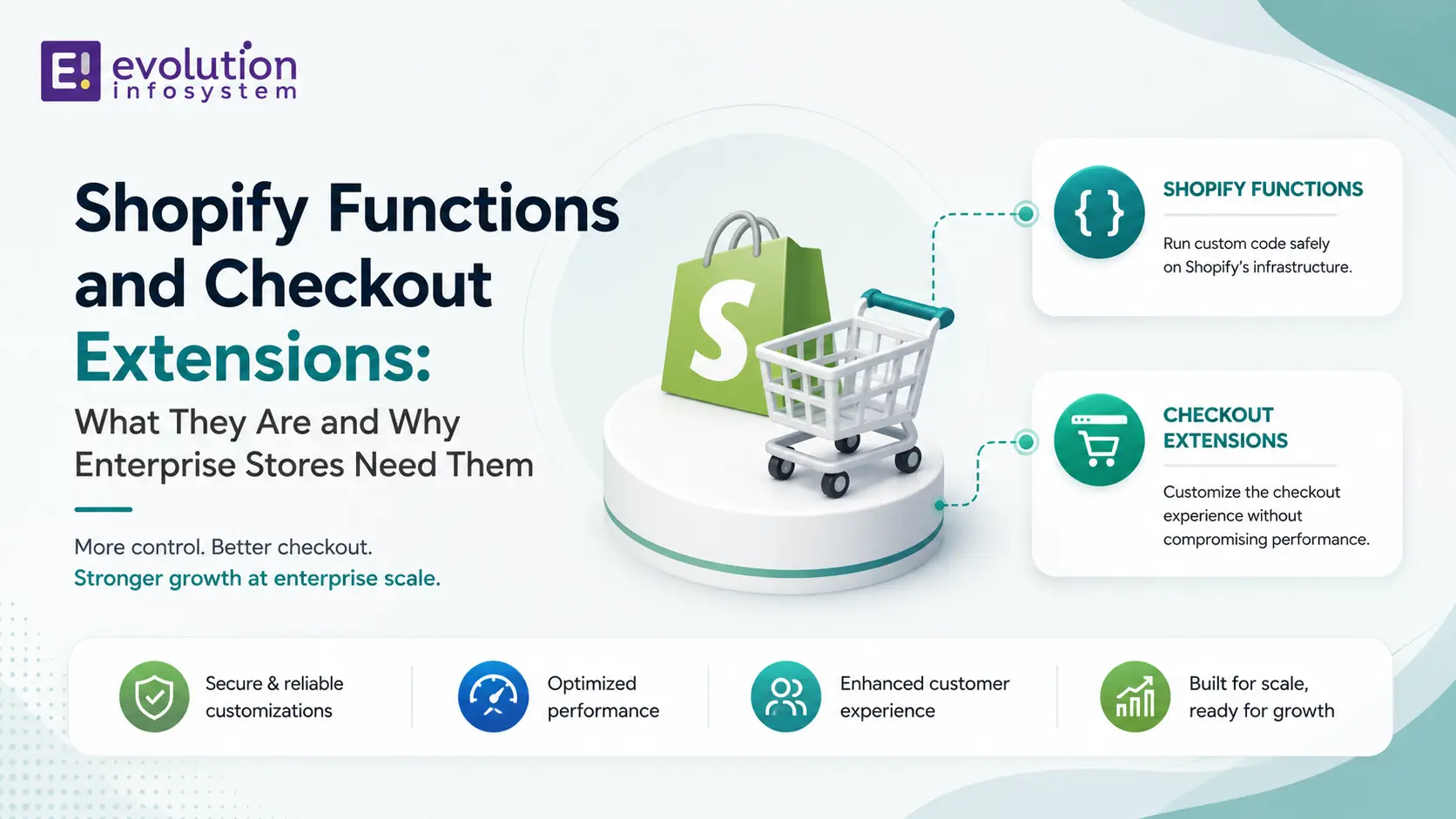
Shopify Functions are custom backend logic that runs inside Shopify’s infrastructure. Instead of intercepting Shopify’s checkout through an external app server – with the latency, reliability, and security implications that brings – Functions execute directly within Shopify’s platform at the point in the checkout where the logic is needed.
Functions can customise four core areas of Shopify’s backend:
→ Discounts.
The default Shopify discount system handles percentage discounts, fixed amount discounts, buy-X-get-Y offers, and free shipping thresholds. Shopify Functions extend this to handle any discount logic you can define in code: tiered pricing, volume discounts, customer-tag-based pricing, combination discount rules, loyalty-point redemption, B2B contract pricing, and any other custom discount logic your business requires.
→ Shipping.
Standard Shopify shipping rates are calculated based on weight, price, or flat rate rules. Functions let you calculate shipping based on any logic: SKU-specific shipping restrictions, shipping by fulfilment location, carrier-calculated rates with custom overrides, shipping rules by customer segment.
→ Payment customisation.
Hide, rename, or reorder payment methods based on cart contents, customer attributes, or any other condition. Restricting payment methods by geography, order value, or product type – all of this becomes possible with Functions.
→ Cart and checkout validation.
Prevent checkout from proceeding when specific conditions aren’t met: minimum order quantities, product combination restrictions, B2B order approval requirements, age verification by product type.
Why Functions are different from app-based customisation:
Before Functions, complex discount or shipping logic required an external app server sitting in front of Shopify’s checkout. Every cart update, every discount calculation, every shipping rate request required a round trip to the app server. This added latency to the checkout experience, created a single point of failure, and required the app to handle Shopify’s traffic spikes reliably.
Functions execute inside Shopify. No external server. No latency overhead. No separate infrastructure to maintain. The business logic runs at Shopify’s performance level, not at your app server’s performance level.
What Shopify Checkout Extensions Are
Checkout Extensions are the frontend equivalent of Functions – they let you add custom UI components to the Shopify checkout without modifying checkout.liquid (which is locked on Shopify Plus) and without the fragility of injecting JavaScript into a page you don’t control.
Extensions are built using Shopify’s Checkout UI Extension API and React-like components. They render directly within the checkout at defined extension points – before the shipping method selection, after the contact information block, on the order confirmation page, and elsewhere
What Checkout Extensions make possible:
→ Custom upsell and cross-sell components.
Offer related products, upgrade options, or complementary items directly in the checkout flow without leaving the page. Upsell offers presented at checkout consistently outperform post-purchase offers on conversion rate.
→ Delivery date and time selection.
Let customers choose preferred delivery windows, special delivery instructions, or subscription delivery schedules directly in checkout.
→ Gift messaging and personalisation.
Custom gift wrapping options, personalised message fields, or special occasion add-ons – all handled directly in the checkout without a separate app overlay.
→ Custom form fields.
Collect additional information specific to your business at checkout: purchase order numbers for B2B orders, project reference codes, installation appointment preferences, dietary requirements for food businesses.
→ Loyalty and rewards integration.
Display points balances, allow points redemption, and show tier benefits directly in the checkout without redirecting customers to a separate loyalty portal.
→ Post-purchase pages.
The order confirmation page is one of the highest-engagement moments in the customer journey. Checkout Extensions let you add upsell offers, subscription prompts, review requests, and referral offers on the confirmation page – all within the Shopify checkout environment.
How Functions and Extensions Work Together
The most powerful implementations combine Functions (backend logic) and Extensions (frontend UI) to create checkout experiences that aren’t possible with Shopify’s standard tools or third-party apps.
Example: Volume discount with real-time UI feedback
A B2B store wants tiered pricing that updates in real time as the customer increases quantity. A Shopify Function calculates the correct price tier based on cart quantity. A Checkout Extension displays the tier structure and shows the customer how close they are to the next tier – “Add 5 more units to unlock 15% off.” Both update in real time as the cart changes, with zero external server dependency.
Example: Custom shipping with geolocation UI
A retailer wants to show estimated delivery dates based on the customer’s postcode, calculated from their actual fulfilment centre locations. A Function calculates the delivery date by postcode and fulfilment location. An Extension displays the estimated delivery date prominently below the shipping method selection, reducing shipping-related checkout abandonment.
Who Actually Needs Shopify Functions and Checkout Extensions
Not every Shopify store needs Functions and Extensions. Standard Shopify’s built-in functionality covers the requirements of most small to medium stores.
The signals that indicate you need them:
→ Your discount logic is more complex than Shopify’s native rules.
Volume pricing by customer segment, contract-specific pricing, complex multi-rule discount combinations, loyalty-point-based discounts. If you’re currently approximating this with multiple manual discount codes or workarounds, Functions are the solution.
→ Your B2B operations have checkout requirements that don’t fit standard consumer checkout.
Purchase order number collection, minimum order value enforcement, payment terms display, account-specific pricing – B2B checkout requirements are almost always better served by Functions and Extensions than by app workarounds.
→ You’re experiencing checkout performance issues from app dependencies.
If your checkout is slow because of multiple third-party apps running scripts, replacing app-based logic with native Functions removes the performance overhead at its source.
→ You need checkout UI customisation that themes or apps can’t deliver cleanly.
If you’re using JavaScript injection to add UI to the checkout – which is fragile and breaks on Shopify updates – Extension-based UI is more stable, better performing, and officially supported.
→ You’re on Shopify Plus and need checkout.liquid replacement.
Shopify is deprecating checkout.liquid in favour of the Checkout Extensibility framework. If you’re on Plus with customised checkout.liquid, migration to Extensions is required.
Frequently Asked Questions (FAQs)
What is the difference between Shopify Functions and Shopify Apps?
Shopify Apps run on external servers and interact with Shopify through APIs. Shopify Functions run inside Shopify’s infrastructure. Functions have lower latency, higher reliability, and no external server dependency. For business logic that runs inside the checkout (discounts, shipping, payment), Functions are the correct tool. Apps remain appropriate for functionality that operates outside the checkout flow.
Do I need Shopify Plus to use Shopify Functions and Checkout Extensions?
Some Checkout Extension points are available on all Shopify plans. Most advanced customisation – particularly custom checkout UI and full Functions capability – requires Shopify Plus. If your requirements extend to checkout customisation, Shopify Plus is the appropriate plan.
What is checkout.liquid and is it still supported?
Checkout.liquid is the legacy theme file that controlled checkout appearance and functionality on Shopify Plus. Shopify has deprecated it in favour of Checkout Extensibility (Checkout Extensions and Functions). Stores still running checkout.liquid customisations need to migrate to the new framework. Shopify’s official timeline requires this migration for continued support.
How long does it take to build a Shopify Function or Checkout Extension?
A single focused Function – for example, a custom volume discount rule – takes 2–4 weeks including development, testing, and deployment. A more complex implementation combining multiple Functions with custom Checkout Extensions typically takes 4–8 weeks depending on the scope of logic and UI components involved.
Can Shopify Functions handle B2B pricing requirements?
Yes. B2B pricing – account-specific contract prices, customer-tag-based pricing tiers, minimum order enforcement, purchase order number collection – is one of the primary use cases Functions were designed for. The combination of a discount Function (handling the pricing logic) and a checkout Extension (handling the B2B-specific UI) covers most B2B checkout requirements that standard Shopify cannot.
At Evolution Infosystem, we develop Shopify Functions and Shopify Checkout Extensions for enterprise and Shopify Plus stores. We build the business logic and checkout UI that the standard platform can’t deliver – from B2B pricing rules to custom upsell flows.Let’s talk about your Shopify customisation requirements.